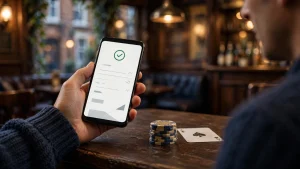
A practical look at low-paperwork registration, traceable blockchain payments, offshore sites, game rules and bonus conditions.

“Anonymous” is an appealing label, but it describes a limited part of the experience: how much personal information a site asks for when an account is opened. At some offshore casinos, registration can involve less identity paperwork than the process at a UK-licensed operator. Gambling is funded with digital coins rather than a conventional card payment. That combination is what people generally mean by a no-KYC crypto casino.
It does not mean that a player is invisible. An account still exists on the casino’s systems, and the site may collect information about its use. Crypto transactions are recorded on public blockchains, even when the record does not display a player’s name. A wallet address is not the same thing as a real-world identity, but it is a traceable identifier. “Anonymous” can therefore describe the front door without describing everything that happens after entry.
I learned to read that distinction carefully from the industry side. A short registration form is a product choice: it removes friction at the point where a customer wants to start. It is not proof that the operator has no way to connect activity to an account, or that it will never ask for further information. Those are separate questions, and the word on a landing page does not settle them.
The UK context matters just as much. The UK Gambling Commission does not license or supervise casinos that accept cryptocurrency payments. British players can nevertheless reach offshore crypto casinos, including sites operating under licences from Curaçao, Anjouan or Costa Rica. A foreign licence is not a UK licence, and the fact that a site is accessible from Britain does not make it part of the British regulatory system.
That distinction is especially important in 2026. The Commission’s requirement remains that an operator serving British residents must hold a UKGC licence. A site’s claims about privacy, a foreign licence or its willingness to accept crypto do not change that requirement. Nor does a low-friction sign-up turn an offshore casino into a UK-licensed one.
So an “anonymous casino” is best understood as a description of a possible registration experience, not a status the operator has earned. The label may mean that an account can be created without the same initial identity paperwork associated with a UK-licensed casino. It cannot promise complete privacy, erase the public record of a crypto transaction, or establish that the site is legitimate in the UK sense.
That is the useful distinction. Less paperwork at the start. No guarantee of anonymity.
A Bitcoin deposit has two separate stages: the casino has to identify the incoming transaction, and the Bitcoin network has to confirm it. Those events are related, but they are not the same thing. A payment can appear in a wallet before the casino credits it to an account, because the operator may wait for network confirmation or apply its own processing rules.
The usual path starts with the casino displaying a Bitcoin address or payment request. Funds are sent from a personal wallet to that destination. Once broadcast, the transaction can be tracked on the blockchain, but a visible transaction is not necessarily a completed deposit. The casino may mark it as pending until the network records confirmations and its own system updates the balance.
That distinction matters when a balance does not appear immediately. The casino cannot make the Bitcoin network confirm a transaction; it can only decide what confirmation status it accepts before crediting funds. A specialist review gives a Bitcoin confirmation estimate of 10–30 minutes, but actual timing can vary with network conditions. The estimate is not a service deadline, and it does not say how quickly a particular casino will update an account after the network has acted.
From the operator’s side, a pending deposit can be a routine payment status rather than a rejected transaction. The useful details are the transaction status, the destination address and whether the casino’s payment page shows the deposit as received. If those details do not match, the issue is different from ordinary confirmation delay. Sending funds to an incorrect address can make recovery difficult, so the payment details deserve checking before a transaction is broadcast.
Withdrawals reverse the direction of travel, but they introduce another distinction. First, the casino reviews and approves the withdrawal request. Then it sends Bitcoin to the destination wallet, and the blockchain records that transaction. “Processed” on an account page may mean the casino has authorised or dispatched payment; it does not, by itself, mean the receiving wallet has a confirmed transaction.
A specialist review reports that withdrawals can be sent after an internal review, with the review taking under an hour at operators it describes as trusted. It also notes that a first withdrawal may be subject to manual review lasting a few hours. These are reported timings, not guaranteed service standards. The review stage is controlled by the casino; confirmation after dispatch depends on the network. A delay in either place can look like the same problem from the account screen.
This is why the status wording matters. “Pending” may refer to a casino check, while “sent” may indicate that a transaction has been broadcast and is awaiting confirmation. A transaction identifier, when supplied, makes it possible to distinguish a blockchain delay from a withdrawal that has not yet left the operator’s system. It does not settle a dispute about whether the casino should have approved the payment.
Bitcoin also changes the value calculation. A deposit is made in BTC, but many players judge the balance in pounds. If Bitcoin’s market price moves significantly between deposit and withdrawal, the pound value of the same amount of BTC can rise or fall. The casino balance may still show the same coin quantity while its sterling equivalent changes. A displayed conversion is therefore a snapshot, not a promise that the original pound value will be preserved.
The reverse can matter too. A withdrawal paid in Bitcoin may arrive as the requested coin amount even when its sterling value has shifted since the request was made. Network confirmation settles the transfer on the blockchain; it does not stabilise the exchange rate or guarantee what the funds will be worth when converted. That is the price risk carried alongside the payment method.
A no-KYC Bitcoin casino may make the deposit step feel direct: a wallet transfer rather than a card payment. That does not make the transfer private in the absolute sense, nor does it remove the casino’s control over when a balance is credited or a withdrawal is approved. Payment speed and account treatment remain separate questions.
The practical reading is simple: a deposit is not complete merely because a wallet sent it, and a withdrawal is not complete merely because a casino marked it processed. Bitcoin confirmation, operator review and market value each sit on a different part of the path. Three separate clocks.
The difference is not simply the presence or absence of a sign-up form. A UK-licensed operator sits inside a system with a named regulator and enforceable rules for serving British customers. The UK Gambling Commission regulates gambling activity, including online casinos, and its reach does not depend on where an operator keeps its equipment: remote gambling offered to consumers in Great Britain still requires the relevant UK licence.
An offshore crypto casino works outside that system. Some sites accept customers from the UK while operating under an overseas licence, but a foreign licence is not a UK Gambling Commission licence. That distinction is easy to blur in promotional copy. “Licensed” can sound like one universal status; in practice, the regulator and the market it oversees matter.
No UK Protection
UK consumer law and dispute resolution routes, such as the gambling ombudsman, are not available for disputes with offshore casinos.
The consequences emerge when something goes wrong. UK consumer law does not protect a customer in a dispute with an offshore casino, and the UK-backed routes for resolving complaints are not available. There is no access to UK alternative dispute resolution or a gambling ombudsman through the UK system. The safeguards associated with UK regulation, including protection through segregated funds, are also absent. A balance shown on screen is not the same as money held under UK consumer protections.
That does not mean every offshore operator will withhold a balance. It means there is no UK framework to rely on if a withdrawal is challenged, an account is restricted or the operator disputes what is owed. Winnings are not guaranteed. The practical weakness is the lack of a UK-backed route to enforce a claim, rather than any certainty about how an individual site will behave.
I used to think that a foreign licence label answered the important question. It did not. It described the operator’s position in another jurisdiction, not the protections available to a British customer. That distinction matters more than the label’s appearance on a footer.
The legal position also separates the player from the operator. Playing at an unlicensed offshore casino is not a criminal offence for an individual in the UK. But remote gambling operators offering services to consumers in Great Britain are required to hold a UK Gambling Commission licence, regardless of where their key equipment is located. Access being possible does not make the site UK-licensed or bring it under UK oversight.
This is why “anonymous” and “UK-licensed” should not be treated as interchangeable selling points. An anonymous casino site may offer a different registration experience, but that does not create UK consumer rights or formal dispute resolution. Nor does a list of attractive features change which regulator is responsible. In operational terms, the customer is dealing with a business outside the UK system, without its complaint protections and safeguards.
The trade-off is plain. Offshore access may appeal to someone seeking crypto gambling, but it comes with weaker recourse if the relationship breaks down. No UK safety net.
The difference between a casino game and the rules around it is easy to miss on a mobile screen. A slot can look familiar whether it is hosted by a UK-licensed operator or an offshore site, but the same appearance does not establish that the same British requirements apply. I separate the two: the game is the interface; the licence determines which regulator’s rules govern the operator.
In Great Britain, remote gambling offered to consumers is regulated by the UK Gambling Commission, even when the operator’s equipment is based elsewhere. An operator serving British customers must hold the relevant UK licence. Offshore sites without one sit outside that framework, so a familiar lobby or game format is not evidence that British safeguards are being applied. A no-KYC casino may make access feel simple; that does not make its games part of the UK-regulated system.
The distinction is clearest with online slots. In Britain, autoplay is prohibited: spins cannot be set to run automatically while the player watches. Each spin must also take at least 2.5 seconds. These requirements shape the pace of play, not merely the wording in the terms. Where a site offers slots to British customers without a UK licence, those British rules are not proof of what the site actually enforces. The interface may offer different controls, and there is no UK regulator supervising it.
Stake limits are another part of the regulated slot experience. The maximum stake for a single game cycle is £5 for customers aged 25 and over, and £2 for those aged 18 to 24. The lower limit for younger adults is a separate rule, not a setting that can be inferred from a game’s appearance. These limits concern online slots; they should not be casually applied to every casino game or every offshore platform.
Age control also happens before play begins. Operators must verify a customer’s age before allowing money to be deposited into a gambling account. In the licensed system, that is a gate before gambling transactions, rather than a warning displayed after a session has started. A registration flow that appears lighter on an offshore site does not change the British requirement for operators serving the market.
Mobile play does not alter those distinctions. A slot designed for a phone can still have a spin button, animation and game cycle that look like those on a desktop. I have found it useful to judge the rules by what the operator is required to do, not by how polished the mobile casino appears. Screen size changes the layout. It does not confer a UK licence.
The same care applies to live tables and other casino formats. Their controls and pace differ from slots, but the broader point remains: game availability is not a reliable sign of regulatory status. A branded table or a familiar game provider may tell something about the content; it does not, by itself, show that the operator is licensed to serve British customers. Nor does the word “best” resolve that question. It is an advertising judgement, not a regulatory category.
For British play, the practical comparison is therefore not simply slots versus tables, or desktop versus mobile. It is a licensed operator applying British requirements against an offshore site operating outside UK Gambling Commission oversight. The latter may still be accessible, but a British player cannot assume that rules on autoplay, spin duration, age checks or slot stakes are being enforced there. Familiar games. Different framework.
For UK readers considering an anonymous crypto casino in 2026, payout speed is one practical detail to check when choosing where to play. This list gives a brief reference point on the payout timing provided for each operator.
Chanze
Chanze lists a payout speed of 1–3 business days.
Dieselwin
Dieselwin lists a payout speed of 1–3 business days.
SlotoSport
SlotoSport lists a payout speed of 1–3 business days.
Revery Play
Revery Play lists a payout speed of 1–3 business days.
BeOnBet
BeOnBet lists a payout speed of 1–3 business days.
Jetsetspins
Jetsetspins lists a payout speed of 1–3 business days.
NightWin
NightWin lists a payout speed of 1–3 business days.
Zombillion
Zombillion lists a payout speed of 1–3 business days.
Amunbet
Amunbet lists a payout speed of 1–3 business days.
SpinFormula
SpinFormula lists a payout speed of 1–3 business days.
“Best” is doing a lot of work in descriptions of no KYC casinos. It may mean that a site accepts cryptocurrency, asks for little paperwork at registration or offers games a player already knows. Those features can make the sign-up feel private and the payment route familiar. They do not make an offshore casino UK-licensed, or make its terms safer.
There is a structural trade-off in the British market. UK-licensed operators must complete customer due diligence before gambling transactions are allowed, and UK-based players cannot use UKGC-licensed operators that offer cryptocurrency withdrawals. Offshore casinos may accept crypto and require less identity information at the outset, but they sit outside UK Gambling Commission oversight. One side asks for checks; the other does not bring UK protections with it.
That distinction matters more than the word “best”. If an offshore operator withholds a balance or disputes a result, UK consumer law does not protect the player in the way it would at a UK-licensed casino. There is no UK-backed dispute resolution, access to an approved alternative dispute resolution service or ombudsman, and no UK requirement for segregated player funds. Winnings are not guaranteed. A privacy feature cannot substitute for any of these safeguards.
From the operator’s side of the counter, ranking language often compresses unlike things into one label. A site can be convenient for a crypto deposit but weak on the protections that matter when something goes wrong. The deciding question is not simply which casino asks for the least information. It is what the player is willing to give up for that convenience. Less friction at registration is not the same as a stronger claim to funds later.
A comparison of operators can help identify differences in how sites present themselves, but a position on a list is not a UK licence or a guarantee of payment. The relevant checks are whether the operator holds a UK Gambling Commission licence, what rules govern the account, and what route exists for challenging a decision. For an offshore site, the first answer is no UK licence; the remaining answers need to be read with that limitation in mind.
This is why “best anonymous casino” is a misleading promise if it suggests that privacy and UK legitimacy can be combined in this market. The UK Gambling Commission does not license or supervise casinos taking cryptocurrency payments. Offshore sites may be reachable from the UK, but operating a remote gambling service for British customers without the required UK licence is not the same as being authorised here. Playing at an unlicensed offshore casino is not a criminal offence for the individual, but it means giving up the protections of the UK system.
The practical choice is therefore between different kinds of friction and risk, not between a private site and a protected one. Crypto access may be the feature that draws attention; the absence of UK recourse is the condition attached to it. A ranking cannot remove that condition.
A no-KYC sign-up can be deliberately light. The registration form may ask for an email address, or the account may be linked to a cryptocurrency wallet. Some sites allow deposits without first asking for a passport or proof of address, such as a utility bill. That describes the entry point, not the whole relationship with the operator.
I have seen “no KYC” treated as if it were a permanent condition: no documents at registration, therefore no documents ever. That is a leap. A casino can postpone an identity request rather than rule it out. The account may work normally at first, then face a request for documents when a particular transaction or account event brings it into view.
A specialist review describes casinos asking for identification in connection with a large withdrawal, suspected suspicious activity, or a move from crypto to fiat. Those are possible triggers, not a schedule that applies across the market. The operator’s terms matter, as does the specific reason it gives for a request. A wallet connection does not establish that the person controlling it will never have to identify themselves.
Operators may request identification documents during a large withdrawal, when suspicious activity is detected, or when moving funds from cryptocurrency to fiat currency.
This distinction changes the practical meaning of a no-KYC casino. It may reduce the information requested during routine registration; it does not promise that funds can always be deposited, played through and withdrawn without further checks. A request can arrive later, when an account has a balance attached to it. That is when the difference between “not required at sign-up” and “never required” becomes more than wording.
The UK position is different. A UK-licensed operator has to carry out customer due diligence before it permits gambling transactions, and it must verify a customer’s age before accepting a deposit. A no-KYC process offered by an offshore casino should not be confused with that regulated onboarding standard, or taken as evidence that the site is licensed to serve Britain.
Nor does a minimal form settle whether access is lawful in every location. The operator and the player are not in the same legal position: serving British customers without the required UK licence is unlawful for the operator, while playing at an offshore site is not a criminal offence for the individual. Local laws still matter, so compliance needs checking before using a no-KYC Bitcoin casino. A short form is not legal clearance.
“ No verification” is a sign-up claim, not proof that an account will never be examined. A no-KYC casino may ask for little information at registration, yet still assess activity behind the scenes. The distinction matters: avoiding an initial document request does not remove the operator’s ability to review an account later.
A specialist review describes soft KYC signals that may include location data, IP addresses, browser or device fingerprints, tracing of blockchain activity and patterns in withdrawal behaviour. These checks need not look like a request for a passport. They can help a casino associate activity with a location, device or wallet, or flag behaviour for a closer look. The particular signals used can vary; their existence does not establish that every site applies them in the same way.
I have seen how a later verification demand can become part of a dispute about funds. In an account dispute recounted by a specialist review, a casino’s security team first blocked an account under clause 6.6, citing suspected fraud and voiding bets. The stated basis later changed to clause 5.4, concerning multi-accounting. The review also alleged that the casino used verification to confiscate funds from players who were in profit.
That account is a reported case, not evidence that every casino acts this way. It does show why the sequence and explanation matter. A request for documents is one thing; a block, voided bets and a changing reason raise separate questions about how the terms were applied. A vague “security check” does not, by itself, explain which conduct is at issue.
For any no-KYC arrangement, the practical risk is that the promise concerns the entry point, while monitoring and account decisions can occur later. Keeping the casino’s terms and correspondence can help establish what reason was given and when it changed. It cannot guarantee a favourable outcome. That is the distinction.
A bonus is not the same thing as cash available to withdraw. The advertised amount may appear in an account as a separate bonus balance, but the terms attached to it determine whether play contributes towards a withdrawal and what must happen first. I treat the headline figure as the start of the calculation, not its result.
The key term is the wagering requirement: the amount of qualifying bets that must be made before bonus-related funds, or winnings from them, become eligible for withdrawal. A specialist review of offshore crypto offers reports requirements ranging from 35x to 50x the bonus amount. That is a reported range, not a condition that applies to every offer. The operator’s own terms are what matter for a particular promotion.
The multiplier can make a modest-looking offer demanding. The important detail is its basis. A requirement may be calculated against the bonus alone or against a combined deposit and bonus amount. Those produce different qualifying totals, so the wording needs to be read before accepting the offer. “Wager 35x” is incomplete unless the terms make clear what is multiplied and which bets count.
A no-deposit bonus can sound especially attractive because it does not require an initial deposit to claim. But “no deposit” describes how the offer is obtained; it does not mean that any resulting balance is immediately withdrawable. The same questions still apply: what wagering is required, which games qualify, and what restrictions apply when a withdrawal is requested? An anonymous crypto casino no-deposit bonus should be judged by those conditions, not by the free-credit label.
Game restrictions can alter the practical value as much as the multiplier. A specialist review reports that some casino bonuses exclude live games from wagering. If a game is excluded, bets placed there may not advance the requirement at all, even if the game is available on the site. Other games may contribute differently under the terms. The distinction is easy to miss when the offer is presented beside a broad catalogue of games.
Bet size can be another constraint. A specialist review notes that maximum bets during wagering can be as low as £5. That is a possible term, not a universal ceiling. If a player exceeds an offer’s stated maximum while the requirement is active, the operator may treat the play as a breach of the promotion conditions. The relevant limit is therefore the one in that offer’s rules, not a general assumption about ordinary play.
The balance display does not settle the question. A casino may show bonus funds and cash funds together, or separate them; either way, the terms define which part can be withdrawn and when. Look for language covering qualifying games, excluded bets, the wagering basis, the maximum bet and what happens if a condition is broken. If those rules are difficult to locate or conflict with the promotional summary, the apparent value is hard to assess.
This is where an anonymous casino review can be less useful than the offer wording itself. Reviews may summarise a promotion, but terms can change and a summary cannot replace the conditions attached to the account. A no-deposit offer can be genuine and still carry restrictions that make it unsuitable for someone expecting immediate access to winnings.
The commercial logic is plain: a bonus encourages continued play, while its conditions define when the operator considers the promotion complete. Treat the advertised amount as conditional value. Read the rules before opting in, and keep the bonus separate in the calculation from money that is already withdrawable. No free money.
A promo code is an entry point to an offer, not a separate set of payout rules. When accepted, it may attach a particular promotion to an account or identify which offer is being claimed. The code itself does not turn a bonus into cash, remove conditions or guarantee that a withdrawal will be approved.
That distinction is easy to miss because the code is the visible part of the deal. The less visible part is the offer’s terms: who can claim it, which deposits or games qualify, and what must happen before bonus funds or related winnings can be withdrawn. A code can be valid while the attached offer remains restrictive.
The phrase “anonymous casino bonus code” can suggest that entering a short string is all that stands between a player and unrestricted funds. It is not. A no-KYC sign-up does not alter the conditions attached to a promotion, and a code cannot promise that the casino will never ask for information later.
I have seen promotional wording do its work by making the reward feel immediate, while the rules govern when it becomes usable. The code may activate the offer; it does not rewrite the contract around it. The distinction matters.
Wagering is one term to inspect closely. A specialist review reported requirements ranging from 35x to 50x the bonus amount at offshore crypto casinos; that is a report about reviewed offers, not a rule that applies to every casino or promotion. The offer’s own wording determines what counts toward completion. Restrictions on eligible games or bet size can also affect how practical the offer is.
So an anonymous crypto casino promo code should be treated as a route to a stated promotion, not as evidence of better terms. The relevant comparison is between the offer shown after code entry and the conditions governing play and withdrawal. If those conditions are unclear, the code has not supplied the missing certainty. It has only opened the offer.
Coins beyond Bitcoin can change the payment experience, but they do not make a casino “truly anonymous”. Each network has its own confirmation process, and a casino may wait for the required confirmations before crediting a deposit. A specialist review puts Litecoin confirmations at a few minutes, compared with 10–30 minutes for Bitcoin; actual timing can vary with network conditions and the operator’s deposit rules.
Withdrawal time has a separate clock. The casino first reviews and approves the request, then broadcasts a transaction; the network must still confirm it. A specialist review describes crypto withdrawals as being sent promptly after internal review, while noting that a first withdrawal may be held for a manual check lasting a few hours. Those are reported conditions, not a deadline or guarantee. A displayed “processed” status may mean only that the casino has released the payment, not that it has arrived in the receiving wallet.
The minimum deposit also depends on the site and coin. A specialist review describes offshore casino minimums around the equivalent of £10, but the amount of cryptocurrency required changes with its exchange value. The equivalent shown at deposit is not a fixed value in pounds: a substantial price movement before withdrawal can leave the returned coins worth more or less in sterling. Network fees can also affect the amount received.
Cashing out to a bank account adds another step. A crypto exchange converting coins into fiat currency may require identity checks, so a no-KYC casino account does not remove KYC from the full route to a bank withdrawal. The exchange controls that process.
I treat the payment method and the exit route as separate decisions. A quick blockchain transfer does not settle the operator’s review, and a crypto balance is not a guaranteed sterling amount. Offshore access also does not change the need to comply with local law.
Playing at an offshore casino without a UK Gambling Commission licence is not a criminal offence for an individual in the UK. However, the operator must have a UKGC licence to serve British residents, and offshore sites do not provide UK-backed consumer protection or formal dispute resolution.
The UK Gambling Commission does not license casinos that accept cryptocurrency, and UK-licensed operators cannot offer crypto withdrawals. A UK player’s access to an offshore Bitcoin casino is not a criminal offence, but the operator must hold a UKGC licence to serve British residents.
Some offshore no-KYC casinos allow registration with only an email address or a wallet connection. They may still request identification for large withdrawals, suspicious activity, or when switching from crypto to fiat.
It is a casino where sign-up may require only an email address or a wallet connection, rather than identity documents at registration. This does not guarantee that the casino will never ask for ID later.
At some trusted crypto casinos, withdrawals are sent after an internal review that can take under an hour; a first withdrawal may undergo a manual review lasting a few hours. After dispatch, Bitcoin confirmation can take 10–30 minutes, depending on network conditions.