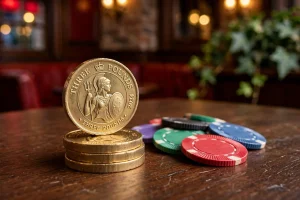
Jackpot labels cover different prize mechanics, from changing progressive pools to fixed awards and prizes tied to release conditions.

“Jackpot” is not one particular feature of a slot. It is an umbrella term for several prize structures, and the label alone does not explain where the prize comes from, whether its value changes, or what event releases it. In practice, jackpot slots can be grouped into four families: progressive, fixed, daily or must-drop, and networked. Those categories describe different parts of the mechanism; they are not four names for the same kind of prize.
That distinction matters when a game is promoted as a jackpot slot game. The word can point to a prize built into one game, a prize that changes over time, a prize shared across a network, or a prize tied to a specified release condition. A title may also combine features. “Jackpot” describes the prize structure, not a promise that a particular spin will pay it.
A progressive jackpot is defined by a changing prize pool. Rather than being a permanently fixed amount, its value can increase as play contributes to it. The key point is the movement of the pool: the displayed prize is not simply a static award attached to a slot.
Progressive is about how the prize behaves, not necessarily how many games or operators are involved. A progressive can be associated with one game or be part of a broader arrangement. The word by itself does not tell the player the pool’s exact funding rules, how much any individual spin contributes, or how the display is updated. Those details belong to the game’s rules.
There is also no scheduled moment at which a progressive must be won. Its trigger can occur at random on any spin, and there is no guaranteed way to make it happen. That separates a progressive prize from a prize whose defining feature is a stated release condition. The pool may change; the timing of its award remains uncertain.
A progressive is therefore best understood as a prize with a variable value, not as a special class of winning spin. The machine’s jackpot display may make the changing amount prominent, but the display does not turn the prize into a prediction.
A fixed jackpot has a set prize value. Its defining feature is stability in the stated award, rather than a pool that grows with contributions. A fixed prize can still be won through the game’s specified trigger, but its amount does not need to be understood as a running total.
This is the most direct contrast with a progressive jackpot. One describes a prize whose value can move; the other describes a prize whose value is set. Neither label, by itself, explains the odds of triggering the prize or how often it is awarded. Those are separate matters, governed by the game’s design and rules.
The word “fixed” can sound like a guarantee. It is not a guarantee that the prize will be won, or that a player will receive it. It describes the prize amount, not the outcome of a spin. A fixed jackpot slot remains a slot game with a prize condition that may or may not be met.
Daily and must-drop jackpots are grouped by the way their release is framed. The important distinction is not simply whether the pool is large or small; it is that the jackpot is associated with a stated timing or release condition. “Daily” signals a time-based framing, while “must-drop” describes a prize that is presented as due to be released under its published rules.
That wording should be read as a description of the mechanism, not as a prediction about an individual player’s session. A must-drop prize does not mean that any particular spin is certain to win it, nor does the label alone say who will trigger it. The exact condition matters. Without that condition, the marketing phrase is not enough to establish how the award works.
A prize with a variable value that increases as play contributes to the pool.
A prize with a set, stable value that does not grow with contributions.
A prize associated with a stated timing or specific release condition.
A shared arrangement where the prize is connected across multiple games or operators.
This is where wording can blur categories. A jackpot may have a changing value and also be described through a release condition. The useful question is not which promotional label sounds most persuasive, but what the game rules say about the pool and the event that awards it.
“Networked” describes the reach of a jackpot: the prize is connected across participating games or operators rather than confined to a single isolated slot. It is therefore different from “progressive” as a description. Progressive refers to a prize whose value can change; networked refers to a shared arrangement. A networked jackpot may also be progressive, but the terms do not mean the same thing.
This distinction is easy to miss in casino jackpot slots because the labels often appear together. A game can be part of a network and feature a progressive prize, while another jackpot can be fixed or tied to a release condition. The category names answer different questions.
When assessing a jackpot slot machine or an online version of one, the practical starting point is the game’s rules: what kind of prize is being described, how its value is treated, and what event can award it. The headline may say “jackpot”; the mechanism is in the detail.
A jackpot slot remains an online slot for regulatory purposes. The word “jackpot” describes a prize feature; it does not create a separate category of gambling with a different stake allowance. In practice, the game presents a stake for a play cycle, runs its outcome through the software and displays any resulting win or feature. The prize may be large, but the legal limit concerns the stake on the slot game, not the size of the jackpot.
That distinction matters when a casino offers slots alongside other games. A roulette spin, a blackjack hand and a live-dealer table game are not online slots simply because they are found on the same casino site. The UK online slots stake cap applies to slots, not to roulette, blackjack or live table games. A jackpot label does not extend the slot rule to those games, nor does a table game become a slot because its interface is delivered on a phone or computer.
The current online slots limits were introduced in stages. Since 9 April 2025, the maximum stake per game cycle has been £5 for adults aged 25 and over. For adults aged 18 to 24, the £2 limit has applied since 21 May 2025. Those are maximums, not recommended stakes or a promise that a game will accept the maximum. A lower stake remains a choice within the game’s available settings.
I have seen promotional copy make the jackpot itself the centre of the description and leave the stake mechanics in the background. That reverses the useful order. The stake is what the player commits to each cycle; the prize is an uncertain outcome. A slot may display a jackpot meter or prize panel, but that graphic does not change the amount permitted for an individual game cycle. Nor does the word “jackpot” exempt a slot from the stake cap.
The practical point is to identify the game, rather than infer its rules from the casino’s menu. If the game is an online slot, the slot limit applies. If it is roulette, blackjack or a live table game, that particular online slots cap does not apply. This is a narrow distinction: it does not mean that other games have no rules or controls. It means only that this specific stake restriction is attached to online slots.
The same principle applies when a slot can be played for real money. The monetary stake is part of each game cycle, and the applicable maximum depends on the player’s age group. The fact that a game offers a jackpot does not turn the stake into a contribution outside the cap. A real-money jackpot slot is still subject to the online slot rule.
The surrounding play mechanics also matter. Online slot autoplay is banned in Britain, so a player cannot set a slot to run a sequence of spins unattended. Individual online slot spins must last at least 2.5 seconds. These requirements shape how a slot session works, even where the game’s presentation encourages rapid play. A vivid animation or a quick transition between screens does not remove the minimum duration or make autoplay permissible.
There is a difference between the game’s pace and the player’s pace. A slot may offer a new cycle as soon as the previous one has finished, but each spin still has to meet the minimum duration and be initiated rather than left to autoplay. That is one reason the slot experience should not be treated as interchangeable with a roulette table or a live blackjack game: the products have different mechanics, and the slot-specific rules attach to the slot product.
Responsible-gambling controls sit alongside those mechanics. UK-licensed casinos must provide reality checks and session reminders at regular intervals, as well as self-exclusion and account-level controls. Those tools do not alter the result of a spin, and they do not change the stake cap. They are part of the operating framework around play. In my experience, the distinction between a game feature and an account control is easy to blur in casino menus. They do different jobs.
For anyone comparing online jackpot casinos, the relevant first question is not whether the prize panel looks impressive. It is whether the game is a slot, what stake is being set for its cycle, and which age-based cap applies. The rules are specific: they limit online slot stakes, while leaving roulette, blackjack and live table games outside that particular limit. A jackpot is a prize feature, not a route around the rule.
When choosing a UK mobile casino for jackpot play, payout timing is one practical detail to check. The entries below state the available payout-speed information for each operator.
Chanze
Chanze lists a payout speed of 1–3 business days.
Dieselwin
Dieselwin lists a payout speed of 1–3 business days.
SlotoSport
SlotoSport lists a payout speed of 1–3 business days.
Revery Play
Revery Play lists a payout speed of 1–3 business days.
BeOnBet
BeOnBet lists a payout speed of 1–3 business days.
Jetsetspins
Jetsetspins lists a payout speed of 1–3 business days.
NightWin
NightWin lists a payout speed of 1–3 business days.
Zombillion
Zombillion lists a payout speed of 1–3 business days.
Amunbet
Amunbet lists a payout speed of 1–3 business days.
SpinFormula
SpinFormula lists a payout speed of 1–3 business days.
A jackpot casino in Britain is not a separate legal category. It is an online casino offering games with a jackpot feature; the word describes part of the product, not a different kind of permission to gamble. The practical meaning of “UK” matters more. A site aimed at customers in Great Britain falls within the UK Gambling Commission’s remit even if its key equipment is based elsewhere.
A specialist affiliate review reported that 80% of UK casino sessions took place on mobile devices. That is a snapshot from one review, not a settled measure of current behaviour. I would not use it to assume that every casino works equally well on a phone, or that a dedicated app is necessary. The mobile experience is a separate practical question.
The regulatory distinction is firmer. The UK Gambling Commission oversees commercial gambling in Great Britain and is the sole regulator for that activity there. Its remit covers remote gambling offered to people in Great Britain, regardless of where the operator’s equipment sits. That is why an overseas location does not, by itself, put a casino outside the rules when it is selling into this market.
The Gambling Act 2005 provides the main legislative framework in England, Wales and Scotland; Northern Ireland is outside that Act’s scope. For commercial operators serving customers in England, Scotland and Wales, the relevant operating licence must come from the UK Gambling Commission. The Commission also issues personal licences to individuals carrying out specified roles in the industry. These are different permissions: one applies to a business, the other to people working in regulated gambling.
For a player, the core condition is straightforward: online gambling is lawful in Great Britain when it takes place through an operator holding the appropriate current UKGC licence. The law permits online gambling for adults aged 18 and over, but the age threshold does not remove the operator’s verification duties. Great Britain’s rules require age and identity checks before online gambling; an account is not simply cleared to play because a form has been submitted.
From behind the counter, that distinction is easy to miss in promotional language. “UK casino” can sound like a description of where a brand was founded, where its website is hosted, or which currency it displays. None of those details establishes authorisation. The relevant point is whether the operator holds the licence required to serve the market. Location is not the test. Permission is.
That also explains why a jackpot label should not be treated as evidence of regulatory status. The same game feature can appear on services with different legal positions, while the word “mobile” says something about access rather than oversight. In this market, the jurisdiction and licence come first; the jackpot description comes after. Separate questions. Different answers.
A comparison can make a casino look attractive by putting a large welcome offer beside a jackpot label. I have found that these are separate things: the offer describes a promotion, while the product is the account, games and operating process behind it. A headline does not tell much about how a withdrawal is handled.
For a useful comparison, I look beyond the first screen. Does the casino explain when identity checks take place, how a withdrawal is reviewed and what happens if a payment is held for verification? Clear descriptions matter more than broad claims about speed. If the process is hard to find before registration, the headline has done its job while the practical information has not.
KYC means Know Your Customer; AML means Anti-Money Laundering. These checks are not peculiar to a jackpot brand. Before any operator can release funds, it must complete the relevant checks on the player. That includes familiar names as well as less familiar ones. A comparison that treats verification as an unusual exception, or implies that a casino can simply pay out without it, gives a misleading picture.
The operational detail worth comparing is how plainly the operator explains its process. The wording should make clear that a withdrawal may depend on checks being completed, rather than presenting payment as an automatic step after a request. I would also look for a coherent route for queries about a pending withdrawal: where a complaint starts, how it is handled internally and what escalation exists if the issue remains unresolved.
That is the unglamorous part. It matters.
A UKGC-licensed operator must have an internal complaints procedure. If that procedure has been exhausted, a player can take the dispute to IBAS, an approved alternative dispute resolution service. IBAS rulings are binding on the licensed operator. A comparison should therefore distinguish between a casino that merely displays a support contact and one whose complaint route can be followed through to independent resolution.
The distinction is practical, not promotional. Customer support can answer a routine question; a formal complaint is the route for an unresolved dispute. The comparison should not blur those functions or imply that a friendly chat response settles a case.
“Best” is an elastic label. In my experience, it often reflects what a page chooses to foreground, not a universal measure of how well an operator handles an account. A more useful assessment sets the offer aside and checks the operating information: verification, withdrawal explanations and complaint escalation. No headline replaces those processes.
That leaves a more grounded comparison: not which casino makes the boldest promise, but whether its terms and procedures explain what happens when the account moves from registration to a withdrawal or a dispute. The offer can change. The process is what the account has to live with.
“Real money” describes play funded from a cash balance rather than from a promotional credit. The distinction matters because a jackpot shown in a game does not, by itself, tell anyone whether a spin is being funded with cash or with an offer. A promo code is a way of attaching an offer to an account; it is not a payment method and does not turn promotional credit into withdrawable cash.
That is the first separation I make when reading casino language: how funds enter the account, what balance funds play, and what rules apply if a balance is later withdrawn. Marketing often puts all three under one “claim” button. Operationally, they are different stages.
In Great Britain, credit cards cannot be used for gambling payments. The restriction also covers a wallet payment where credit-card funds can be used to gamble, and credit-card funding routed through a money service business. A payment route does not become acceptable simply because the card is one step removed from the casino account.
Credit Card Ban
Credit cards cannot be used for gambling payments in Great Britain, including wallet payments where credit-card funds are used.
That makes “deposit options” a more useful detail than a broad claim about convenience. The relevant question is whether the route is permitted for gambling, not merely whether a payment brand appears in a cashier or can be used elsewhere online. A displayed logo is not a substitute for checking the payment rules attached to the account.
The restriction is about the funding method, not about whether a jackpot is progressive, fixed or promotional. It also does not mean that every cash balance and every promotional balance follows the same withdrawal treatment. Those are separate terms.
A jackpot casino promo code may unlock an offer, but the code itself is not cash and does not establish the value or withdrawability of any resulting balance. The same applies to “free spins”: the phrase describes a promotional feature, not a promise that any winnings can be withdrawn without conditions. The terms attached to an offer determine how it works; the payment rules determine which funding routes may be used.
I have seen the cashier treated as a footnote after the headline offer. That reverses the practical order. A promotion can look clear while the payment route remains unsuitable, or the offer can be available while its resulting balance is subject to separate conditions. Read them as distinct parts of the account.
A search for a jackpot casino withdrawal time can suggest that one figure applies to every account and payment route. It does not. A stated processing estimate is an operator’s description of its process, not a universal timetable. Before treating an advertised withdrawal as a cash outcome, check the applicable withdrawal terms and whether the balance being withdrawn is cash or promotional.
Keep the categories separate: funding eligibility, promotional conditions and withdrawal processing. That is where the wording stops being decoration.
A “welcome bonus” is an offer attached to opening an account; “sign-up bonus” is often another label for the same kind of promotion. Neither phrase tells the whole story. The headline may describe bonus funds, spins or another offer, but it does not make that value withdrawable cash. The terms determine what is credited, which games qualify, how the promotion must be used and when any resulting balance can be withdrawn.
A no-deposit offer is presented as available without making a qualifying deposit. That wording still needs to be read alongside its conditions: eligibility, expiry, game restrictions and any limits on withdrawing winnings may all matter. “No deposit” describes one part of the offer, not an unconditional payment from the casino. I have seen the headline do its job before the terms do theirs. Read the small print.
The same distinction applies when a promotion is described as a jackpot bonus. The label does not establish that bonus funds can be used on every jackpot game, or that a jackpot win will be treated like an ordinary cash balance. Promotional terms can restrict eligible games and how play contributes toward release conditions. Progressive jackpot slots should not be treated as contributing to bonus wagering requirements. That is a practical distinction, not a footnote.
Before accepting an offer, the useful questions are plain: what must be done to qualify, which games are excluded, how long the offer remains available, and what happens to the bonus and any associated winnings if the conditions are not met? If the wording is unclear, the headline cannot resolve it. Nor should an advertised bonus be confused with the player’s own funds or with a guaranteed return.
There is also a separate account-control step before money is deposited. UK regulatory guidance requires remote gambling businesses to ask new customers to set a financial limit before their first deposit, and to make limit-setting facilities accessible in the account. The financial limit is not a bonus condition. It is a control over gambling spend, and should remain visible and usable after the sign-up flow has ended.
That separation matters. A promotion can encourage a deposit; a financial limit defines a boundary for spending. They serve different purposes, even when both appear during registration. I would not read a prominent bonus panel as evidence that the account controls are equally easy to find. Check the account settings and the terms independently.
The sensible reading order is therefore not the largest number on the offer card. It is the qualification rules, eligible games, withdrawal conditions and account controls. The headline attracts attention. The terms decide what it means.
A progressive jackpot is not simply a large prize attached to a slot. Its defining feature is that the prize pool can grow while the game is being played. In a networked version, participating operators feed the same pool: once it has reached its starting floor, each spin across the network adds a slice. The amount is therefore connected to activity across the participating games, not just to play at one casino.
That distinction matters when a jackpot is described as “live”. The word can refer to a pool whose displayed value changes as contributions arrive. It does not mean the prize is due to be paid at a known time, or that a live display reveals when the trigger will happen. A growing figure is evidence of contributions, not a countdown.
I have seen promotional copy make a rising total feel like a promise in motion. It is not. The progressive can trigger at random on any spin, and there is no guaranteed method for making it happen. The pool may keep growing before a trigger, but its current size does not turn the next spin into a scheduled event. The trigger remains uncertain.
Stake size is another point that can be obscured by the headline. For this progressive mechanism, the trigger is independent of the stake: a £0.10 spin and a £5 spin face the same trigger. A larger stake does not buy a better chance of hitting the progressive. The contribution mechanism and the trigger mechanism are separate ideas; treating them as one leads to a misleading impression of how the prize works.
When a game is offered by more than one operator, the network is the relevant unit for understanding the pool. A spin at one participating operator can contribute alongside spins elsewhere in that network. This is why a networked progressive may rise beyond what activity at a single casino would suggest. It is also why the operator’s branding is not enough to explain the prize: the pool depends on which games and operators participate.
Casino reviews can describe a jackpot as “shared” or “live”, but those words are useful only when they clarify the mechanism. The practical distinction is whether the advertised amount belongs to a pool fed by play across a network, rather than a prize maintained separately within one game or operator. A review should make that distinction legible, not imply that a visible total makes a payout predictable.
The pool can grow. The trigger cannot be booked.
A specialist affiliate review reported that 80% of UK casino sessions took place on a mobile device. That is a snapshot from one type of source, not a permanent measure of how every player behaves. It does, however, show why mobile access has become central to the way jackpot games are presented.
“Mobile casino” can mean a casino opened in a phone’s web browser, or a dedicated app installed on the device. Those are different routes to the same basic task: opening a game and using its controls on a smaller screen. The word “app” in a search or advert does not, by itself, establish that a separate download is required. Nor does it say whether the game is available through a browser.
On a phone, the practical test is the interface. Game controls need to remain legible, the spin button should be easy to identify, and any jackpot information should be visible without obscuring the play area. A screen can technically load while still making the important details awkward to read. That is a usability issue, not a feature of the jackpot itself.
I have seen mobile descriptions lean heavily on the word “seamless”. What it often means is simply that the page has been adapted to a narrow display. It does not tell anyone how the game looks on a particular handset, whether the connection is stable, or whether an app offers anything beyond browser access. Those details need to be checked in the actual interface.
The same caution applies to claims about a “jackpot casino app”. The label may describe an app-based route into a casino catalogue, not a separate class of jackpot games. A game’s jackpot mechanics do not change because it is opened from an icon rather than a browser tab. The screen and navigation do.
That distinction matters when comparing descriptions of jackpot casino games on mobile. A list of titles says little about whether the relevant games can be found and operated comfortably on a phone. Conversely, a polished mobile layout does not make a jackpot more likely to trigger. The device changes the experience of access, not the underlying game outcome.
Small screen. Same uncertainty.
A crypto payment option and a gambling licence answer different questions. The first describes how a site says it handles deposits or withdrawals; the second identifies the regulator overseeing the operator. One does not prove the other. A jackpot casino advertising digital-asset payments may still sit outside the UK regulatory system.
For customers in England, Scotland and Wales, the decisive distinction is UK Gambling Commission authorisation. Remote operators offering gambling to consumers in Great Britain need the relevant Commission licence, wherever their equipment is based. A licence issued elsewhere is not a substitute. Offshore crypto casinos without UKGC authorisation are outside that system, even if their own pages display a foreign licence or describe the service as international.
A check of the Curaçao Gaming Authority’s public register currently shows Usoftgaming N.V. with an active business-to-consumer licence, reference CGA/2025/1353/1345. That entry establishes a Curaçao licence for the named company; it does not establish that any operator using crypto, or any jackpot brand, holds a UKGC licence. The regulator and the legal scope are different. Keep the distinction exact.
I have seen licence badges treated as if they travelled with a brand across every market. They do not. The operator’s legal entity matters, as does the authority that issued the licence and the market the licence covers. A foreign register entry is evidence of that register’s status, not permission to serve British customers under UK rules.
A separate check of the Curaçao regulator’s public register found no entry for Hustles Casino. That is a limited finding about the register checked; it should not be inflated into a claim about every company or trading name connected with the brand. Equally, a missing entry cannot be turned into UK authorisation. Different question.
The same care applies to lists labelled “top” jackpot casinos. A ranking cannot bridge a licensing gap, and a crypto feature cannot make an offshore operator equivalent to a UKGC-licensed one. In Great Britain, online gambling is legal through sites holding the required UK licence. The practical point is plain: assess the operator’s UK regulatory status, not the currency advertised or the presence of a foreign licence number.
The question of how often a slot pays its jackpot sounds as if there should be a useful timetable behind it. In practice, a past result cannot tell when the next one will arrive. A progressive jackpot may trigger at random on any spin, and there is no guaranteed method for making that happen.
I have seen players treat a long wait as evidence that a jackpot is “due”. It is not. The absence of a recent win does not turn the next spin into a stronger candidate, and a recent win does not make another one predictable. Each spin leaves the timing uncertain.
That is the distinction between a reported hit frequency and a forecast. A record of previous jackpots describes what has happened; it does not provide a date, spin count or pattern that identifies the next trigger. The odds of winning cannot responsibly be translated into a promise about how long a particular player will wait.
Nor is there a method for learning how to win a slot jackpot by choosing a particular moment or following a sequence. The trigger is not something a player can schedule. Claims that a machine is “ready” because it has gone quiet dress uncertainty up as insider knowledge.
I keep the answer plain: the jackpot might arrive on a spin, but no spin can be identified in advance as the one that will trigger it. Hit frequency describes outcomes after the fact. It does not make the next outcome knowable.