Supported Cryptocurrencies and Wallet Deposits: Rainbet UK
Updated November 2026
Licensed
 Available in GB
Fast payouts
18+ Only
Current payment mechanics, with UK scope kept separate
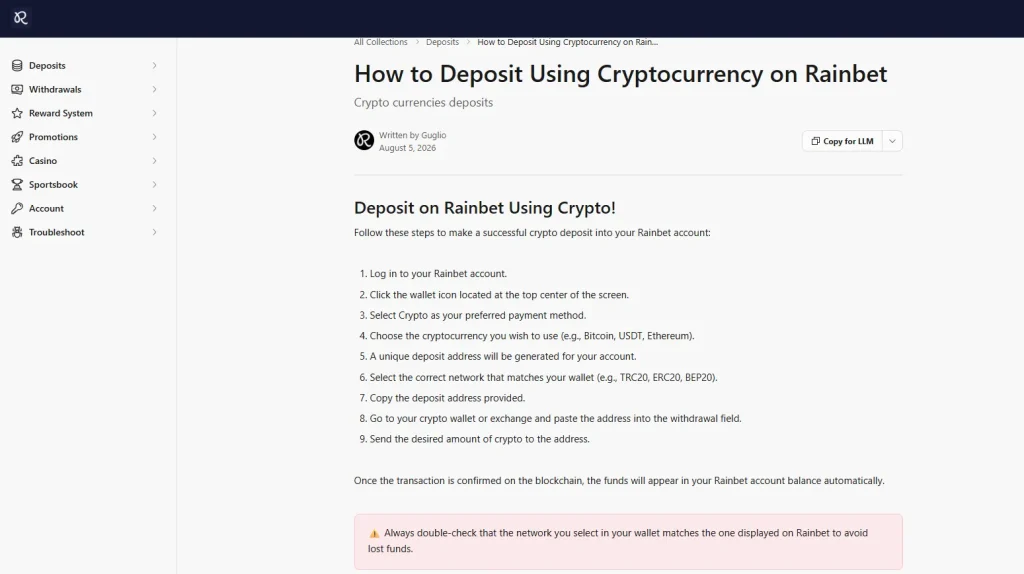
Rainbet is a crypto-focused gambling brand at payment level: its current official deposit guide documents cryptocurrency funding and names Bitcoin, USDT and Ethereum as examples. The critical operational step is not simply choosing a coin. Rainbet tells users to select the same blockchain network in the sending wallet that the Rainbet deposit screen displays, with examples including TRC20, ERC20 and BEP20. That brand-level crypto support does not establish UK access. Rainbet’s current Terms list the United Kingdom among restricted jurisdictions, so crypto functionality must not be framed as a workaround or as proof that UK residents can use the cashier.
Crypto-first payment architecture
Table of Contents
- Verified Rainbet Crypto Deposit Options, Blockchain Networks and Limits
- A correct coin on the wrong network can still be a bad transfer
- How to read the Rainbet cashier without turning it into crypto investment advice
- Crypto payout speed has two clocks: Rainbet processing and blockchain confirmation
- Crypto support does not mean identity checks can never occur
- Crypto capability is not evidence that Rainbet accepts UK players
- What to verify before treating a crypto deposit as complete
- Why crypto support does not change Rainbet’s UK access position
- Deposit Options and Cashier Limits: Rainbet Payments UK
Verified Rainbet Crypto Deposit Options, Blockchain Networks and Limits
Rainbet’s official crypto deposit guide, updated August 5, 2026, documents a wallet-based flow. The user opens the Rainbet wallet, selects Crypto, chooses an asset, receives a unique deposit address, selects the network that matches the sending wallet and then sends the funds. The article names Bitcoin, USDT and Ethereum as examples. Those examples are enough to establish that Rainbet supports cryptocurrency deposits at brand level. They are not a promise that only those three assets are available, and they do not establish a complete current coin list. Crypto menus can change, so the live wallet remains the source for the exact asset and network combination offered to an eligible account.| Step | What to verify | Why it matters |
|---|---|---|
| Asset selection | The intended coin or token | Different assets use different deposit addresses and settlement rules. |
| Network selection | The network displayed by Rainbet | The same token can exist on multiple chains. |
| Address check | The destination generated for that deposit | Blockchain transfers are generally not reversible by a card-style chargeback. |
| Confirmation | Blockchain status after sending | Rainbet says funds appear after the transaction is confirmed. |
The highest-impact check
A correct coin on the wrong network can still be a bad transfer
Rainbet explicitly tells users to match the network selected in the external wallet with the network displayed for the Rainbet deposit. Its guide gives TRC20, ERC20 and BEP20 as examples. The point is not that one of those networks is always preferable; the point is that the selected network has to match the deposit instruction for that specific transaction. This is the non-generic operational risk in a crypto cashier. A user can choose the right asset ticker and still route it over an incompatible chain. Because cryptocurrency transfers do not have the same reversal path as a conventional card payment, checking the network before authorising a transfer matters more than comparing a small difference in confirmation speed.Wallet process
How to read the Rainbet cashier without turning it into crypto investment advice
A crypto casino payment page should answer operational questions, not speculate about token prices. For a deposit, the useful checks are whether the asset is supported, which network Rainbet displays, whether the sending wallet can use that network, and when the blockchain shows confirmation. Price forecasts, trading strategies and leverage have nothing to do with the reliability of the payment rail. That distinction also prevents misleading GBP conversions. A fixed GBP conversion would be misleading because the live value of a crypto asset can change between deposit preparation and settlement. For a UK reader, quoting a fixed sterling equivalent would imply a precision that the source does not provide. The broader Rainbet payment methods compares brand-level payment architecture with UK context. This crypto page stays focused on blockchain mechanics and transaction-risk controls. That scope matters.From deposit to cashout
Crypto payout speed has two clocks: Rainbet processing and blockchain confirmation
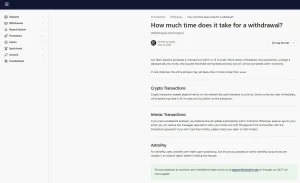
Rainbet’s current withdrawal timing article says the team typically processes transactions within 5-15 minutes. It then treats crypto confirmation as a separate stage, noting that network fee choice and the currency used can affect speed, with some transactions taking 5-45 minutes to confirm. Those figures describe different parts of the payout chain. A user comparing crypto payments should therefore avoid the shorthand “withdrawals take 5-15 minutes.” A more accurate reading is that Rainbet publishes a short operator-processing estimate and then acknowledges external blockchain confirmation time. The dedicated Rainbet withdrawals explains this timing anatomy and the account-review stage in more detail. The same separation is useful when troubleshooting. A request can be approved by the operator while still waiting for a network confirmation, or it can remain inside the account because of a restriction or verification request. Identifying the stage is more informative than judging the entire payout by one stopwatch.Conditional verification
Crypto support does not mean identity checks can never occur
Rainbet’s current KYC help article says cryptocurrency transactions do not routinely require KYC to play or withdraw, but it also states that additional verification can be requested for suspicious account activity. Separately, the account-restrictions article lists anti-money-laundering controls, age verification and suspected fraud among reasons an account can be restricted. The accurate description is therefore a conditional verification model. It is not appropriate to market Rainbet as a “no-KYC” service, because the operator retains verification and restriction mechanisms. Exact document requirements and processing times are changing high-risk details and belong in the Rainbet KYC after a current primary-source check. For payment planning, this means blockchain settlement and account eligibility should be treated independently. A technically valid transaction does not override account rules, and a crypto payment rail does not remove the operator’s ability to perform security or identity checks.Jurisdiction is a separate layer
Crypto capability is not evidence that Rainbet accepts UK players
Rainbet’s current Terms list the United Kingdom of Great Britain and Northern Ireland among restricted countries. That direct restriction is separate from the existence of Bitcoin, USDT, Ethereum or other blockchain rails in Rainbet’s global product. A cryptocurrency address is a payment mechanism, not proof of account eligibility in a jurisdiction. Crypto is not a route around local restrictions, and VPN, geolocation-bypass or account-circumvention guidance would conflict with the operator’s terms. Crypto support also does not establish UK-specific access, consumer protection or GBP payment availability. Readers who need the jurisdiction question rather than the payment mechanics should use the Rainbet UK access. Keeping payment architecture and legal availability separate makes both topics clearer.What to verify before treating a crypto deposit as complete
The deposit process is easiest to audit as a sequence rather than as one action. First confirm the asset selected in Rainbet. Then confirm the blockchain network shown for that deposit. Finally confirm the destination address before authorising the transfer. Rainbet’s own guide separates those fields, and that separation is important because choosing the intended token does not by itself prove that the network and address are correct. After sending, the next question is status. Blockchain confirmation and Rainbet’s own account processing are different stages, just as they are on withdrawal. A transaction can therefore be technically valid on the network while the account still has a separate processing or verification issue. Looking at each stage independently gives a clearer diagnosis than treating every delay as the same type of payment problem. This also explains why crypto support should be described as payment infrastructure rather than account eligibility. The existence of an address, network or supported asset says how an eligible account can move value; it does not change Rainbet’s country restrictions or remove the possibility of account checks. Keeping those layers separate is the safest way to interpret what the cashier actually proves. A final check is consistency between the information shown before and after the transfer. The asset, network and destination used to send funds should match the transaction being tracked, while any account message should be read as a separate operator-side status. This makes it easier to distinguish a blockchain confirmation issue from an account restriction or verification request without assuming that one automatically explains the other.Decision point