Rainbet Responsible Gambling: Self-Exclusion, Loss Limits and UK Benchmarks
 Available in GB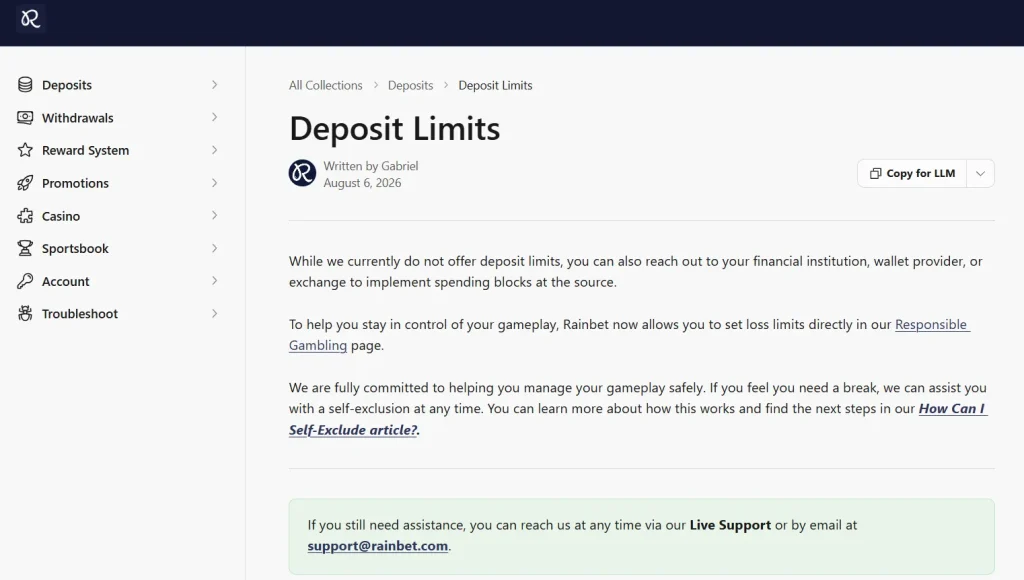
Rainbet provides its own self-exclusion process and lets users set rolling loss limits, but its Help Center currently says that direct deposit limits are not offered. These are Rainbet account tools, not UK regulatory protections. UKGC-licensed online gambling businesses operate under a different framework that includes GAMSTOP participation, financial-limit prompts, financial vulnerability checks and statutory online-slot stake caps. No UK Gambling Commission licence was verified for Rainbet in the public register on 11 September 2026, so this page does not present GAMSTOP or other UKGC safeguards as Rainbet features. It compares the two systems so UK readers can see the practical difference.
Table of Contents
- Rainbet tools and UK-regulated safeguards are not the same thing
- How Rainbet self-exclusion works
- Rainbet loss limits use rolling daily, weekly or monthly windows
- Rainbet currently says it does not offer direct deposit limits
- GAMSTOP is a Great Britain licensing safeguard, not a verified Rainbet feature
- UK rules add financial-limit prompts and vulnerability checks
- UK online-slot stakes are capped at £5 or £2 per game cycle
- Which safer-gambling control matters for your decision?
- Responsible-gambling controls are one part of the wider Rainbet trust picture
- Where Rainbet’s safer-gambling tools differ from UK-regulated expectations
- Rainbet Licence and Ownership: Anjouan Status vs UKGC Licensing
Rainbet tools and UK-regulated safeguards are not the same thing
The most useful way to assess safer-gambling controls is to separate product features from regulatory obligations. Rainbet can publish an account-level control without that control becoming part of the UK system. Likewise, a protection required of Great Britain-licensed businesses cannot be attributed to Rainbet unless Rainbet is actually covered by that requirement.
| Control | Rainbet position | UK-regulated benchmark |
|---|---|---|
| Self-exclusion | Rainbet documents an account self-exclusion process with confirmation steps and fixed exclusion periods. | UKGC-licensed online operators must maintain self-exclusion arrangements and participate in GAMSTOP ONLINE. |
| Loss limits | Available in Rainbet account settings on daily, weekly or monthly rolling periods. | UK-regulated operators must provide financial-limit facilities and prompt new customers to consider setting a limit. |
| Deposit limits | Rainbet’s Help Center says direct deposit limits are not currently offered. | UK rules require accessible customer-led financial limits; the exact technical definition continues to evolve under RTS requirements. |
| Financial vulnerability checks | Not presented here as a verified Rainbet feature. | Remote UKGC licensees are subject to light-touch financial vulnerability checks at the regulatory threshold. |
| Online slot stake caps | Not presented as a Rainbet control. | For UKGC-licensed online slots, the cap is £5 per game cycle for age 25+ and £2 for ages 18-24. |
The distinction matters because a familiar label such as “responsible gambling” does not imply that two operators provide equivalent controls. A reader comparing Rainbet with a Great Britain-licensed site should check which protections are product choices and which are enforceable licence conditions.
How Rainbet self-exclusion works
Rainbet’s current Help Center says users can start self-exclusion from the Responsible Gaming area at the bottom of the site. The process directs the user to request self-exclusion and confirm the request through a link sent to the registered email address.
The documented process then applies a 24-hour cooldown before a further email lets the user select an exclusion duration. Rainbet states that an active exclusion is final for the selected period, locks the account and prevents participation in Rainbet activities. A permanent closure request has an additional staged process after exclusion periods.
Those steps make Rainbet self-exclusion more substantial than a simple “take a break” message because the help article describes an account lock and a confirmation process. It is still a single-operator mechanism. It should not be confused with GAMSTOP ONLINE, which is designed to block access across participating Great Britain-licensed online gambling businesses through one registration.
For a UK reader, that scope difference is decisive. Rainbet’s own self-exclusion can only be described from Rainbet’s published process. There is no verified basis here to say that a Rainbet exclusion propagates into GAMSTOP, another casino, a betting account, or a UK regulatory database.
Rainbet loss limits use rolling daily, weekly or monthly windows
Rainbet introduced direct loss limits that can be set from account settings. The Help Center describes daily, weekly and monthly timeframes and explains that the calculation is rolling and retroactive. In practical terms, the system looks back at net losses inside the selected period rather than resetting only at a calendar boundary.
That rolling design matters. If a user’s recent net losses have already reached the chosen threshold when a limit is set, Rainbet says wagering can pause immediately until enough older activity falls outside the rolling window. This makes the control responsive to recent play rather than only future bets.
A loss limit is not identical to a deposit limit. Deposits measure money entering an account; net-loss limits focus on gambling outcomes over a period. A player can therefore encounter very different behaviour from the two tools even when the same headline number is used. Rainbet currently documents the loss-limit control, while its separate deposit-limit Help Center article says direct deposit limits are not offered.
Anyone deciding whether the available control is sufficient should start with the behaviour they want to restrict. If the goal is to cap gambling losses after play begins, Rainbet’s loss limit is the relevant documented tool. If the goal is to restrict how much money can be transferred into the gambling account, Rainbet’s published information says that specific direct control is absent.
Rainbet currently says it does not offer direct deposit limits
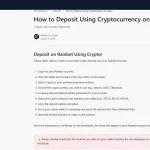
Rainbet’s Deposit Limits article, dated August 2026, states that the platform currently does not offer deposit limits. The same page points users towards loss limits, self-exclusion and spending blocks that may be available through a bank, wallet provider or exchange.
This is a useful example of why responsible-gambling pages should be read literally. A site can offer some controls and not others. It would be inaccurate to infer a deposit cap merely because a loss limit exists, or because a third-party financial provider may offer a separate block.
The Rainbet registration explains the account setup context, while the Rainbet licence covers the regulatory status that determines which local protections can safely be attributed to the operator.
GAMSTOP is a Great Britain licensing safeguard, not a verified Rainbet feature
The UK Gambling Commission describes GAMSTOP ONLINE as the national online multi-operator self-exclusion scheme. Gambling businesses licensed for relevant online activity in Great Britain are required to participate, allowing a consumer to make one self-exclusion request that applies across participating online operators.
That cross-operator scope is materially different from Rainbet’s documented account-level exclusion. No UKGC licence was verified for Rainbet in the UKGC public register on 11 September 2026, and Rainbet’s current Terms list the United Kingdom among restricted jurisdictions. This page therefore does not claim Rainbet participates in GAMSTOP or that a Rainbet user receives UKGC consumer-protection coverage.
There is also no workaround guidance here. If someone has chosen GAMSTOP or another exclusion mechanism because gambling is causing harm, bypassing it would defeat the purpose of the protection. The relevant comparison is simply that GAMSTOP is part of the UK-regulated environment and Rainbet’s own exclusion is a separate operator process.
UK rules add financial-limit prompts and vulnerability checks
For Great Britain-licensed online gambling, customer-led financial controls go beyond making a settings page available. UKGC guidance states that new customers must be prompted to set a financial limit before making their first deposit, with ongoing reminders for active customers to review account activity and limits.
The UKGC also requires remote licensees to conduct light-touch financial vulnerability checks when the relevant threshold is met. The current rule uses public-record indicators such as bankruptcy orders and specified debt judgments, and since 28 February 2025 the threshold is net deposits exceeding £150 in a rolling 30-day period. The Commission describes these checks as separate from financial risk assessments.
These requirements are regulatory benchmarks, not evidence about what Rainbet does internally. They show what a UKGC-licensed environment expects around financial control and customer interaction. Because no Rainbet UKGC licence was verified, those duties should not be attributed to Rainbet by analogy.
The practical lesson is to compare the control itself rather than the terminology. A voluntary loss limit, a prompted customer-set financial limit and a regulator-triggered vulnerability check address different risks and activate in different ways.
UK online-slot stakes are capped at £5 or £2 per game cycle
Great Britain’s statutory online-slot limits provide another clear benchmark. For remote casino licences, the maximum stake per online-slot game cycle is £5 for adults aged 25 and over and £2 for adults aged 18 to 24. The £5 limit took effect on 9 April 2025 and the £2 limit followed on 21 May 2025.
The UKGC makes clear that these caps apply to online slots, not to casino games such as roulette or blackjack. They are product-design restrictions attached to Great Britain remote casino operating licences rather than an optional account setting selected by the player.
For that reason, the limits should not be presented as Rainbet’s limits. Readers exploring the Rainbet games should treat the £5/£2 figures only as a UK-regulated comparison point for online slots.
Which safer-gambling control matters for your decision?
Different controls solve different problems. A self-exclusion mechanism is designed for stopping access. A loss limit is designed to stop wagering after a chosen loss threshold. A deposit limit constrains money entering the gambling account. A multi-operator scheme broadens exclusion beyond one brand. Regulatory vulnerability checks place an additional duty on the operator rather than relying only on a customer to activate a tool.
- If you need one-brand account blocking: Rainbet documents its own self-exclusion route.
- If you want a rolling loss ceiling: Rainbet documents daily, weekly and monthly loss-limit periods.
- If you specifically require a direct deposit cap: Rainbet currently says it does not offer one.
- If you need GAMSTOP coverage or UKGC-enforced controls: do not assume Rainbet provides them; no UKGC licence was verified.
- If geographic access is the question: read the separate Rainbet UK access analysis, because safer-gambling tools do not override country restrictions.
This feature-by-feature approach is more useful than treating a generic responsible-gambling badge as proof of equivalent protection. It also avoids using one positive control to fill gaps elsewhere in the framework.
Responsible-gambling controls are one part of the wider Rainbet trust picture
Safer-gambling features should be assessed alongside licensing, access terms, support and complaint handling rather than in isolation. Rainbet’s self-exclusion and loss-limit tools are concrete product controls, while the missing direct deposit-limit tool is also a concrete limitation.
The Rainbet reputation looks at those broader trust signals without treating review-platform allegations as regulatory findings. That separation is useful because a platform can implement a meaningful account control and still differ sharply from UK-regulated expectations in other areas.
Where Rainbet’s safer-gambling tools differ from UK-regulated expectations
Rainbet’s current responsible-gambling toolkit has two clear documented strengths: account self-exclusion and configurable rolling loss limits. Its own Help Center also identifies a clear gap by stating that direct deposit limits are not currently offered.
The UK-regulated benchmark is broader. UKGC-licensed online operators must participate in GAMSTOP ONLINE, prompt new customers around financial limits, apply financial-vulnerability requirements and observe statutory online-slot stake caps. Those protections should not be attributed to Rainbet. No UKGC licence was verified for Rainbet in the public register on 11 September 2026, and current Rainbet Terms list the United Kingdom as restricted.
For a UK reader, the responsible-gambling question is therefore not simply whether Rainbet has tools. It does. The more important question is whether the particular safeguards you rely on are available at the operator level and backed by the regulatory framework you expect. On that comparison, Rainbet’s published controls and the UKGC-licensed model are materially different.
For related coverage, see the Rainbet review.
Rainbet Licence and Ownership: Anjouan Status vs UKGC Licensing

Is Rainbet Legit? Reputation, Complaints and Trust Signals
Rainbet UK Guide Trust signals Rainbet has several verifiable institutional and product-level trust signals: it...
Can You Use Rainbet in the UK? Terms, UKGC Rules and Access Status
Rainbet UK Guide UK access status Rainbet's current Terms explicitly list the United Kingdom of...