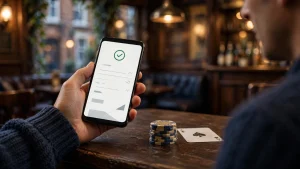
Revolut availability can depend on the payment route, account checks and the casino’s current cashier options.

A casino’s claim that it accepts Revolut is not a universal approval of every Revolut payment. In practice, acceptance depends on what the casino’s cashier offers and whether the particular card or payment route is eligible for that transaction. A logo on a promotional page is a broad signal, not a guarantee that a deposit will go through.
I have seen payment descriptions treated as if they were fixed features of a site. They are not. A cashier is the operational point where an operator presents the methods it can currently process for an account. The available choices can be narrower than the wording on a general payments page suggests. The useful question is therefore not simply whether a casino mentions Revolut, but whether the relevant route is actually available in its cashier.
That distinction matters because Revolut is not a single button that every casino processes in the same way. A payment may be handled as a card transaction or through another route, and the operator’s systems determine what they accept. A site can list Visa or Mastercard while still requiring a check of current availability and product eligibility. The brand name alone does not settle that question.
If you plan to use Revolut at a UK casino, check the available payment methods before depositing. This list gives a payout-speed detail to consider, but does not confirm Revolut acceptance.
Chanze
Chanze lists a payout speed of 1–3 business days.
Dieselwin
Dieselwin lists a payout speed of 1–3 business days.
SlotoSport
SlotoSport lists a payout speed of 1–3 business days.
Revery Play
Revery Play lists a payout speed of 1–3 business days.
BeOnBet
BeOnBet lists a payout speed of 1–3 business days.
Jetsetspins
Jetsetspins lists a payout speed of 1–3 business days.
NightWin
NightWin lists a payout speed of 1–3 business days.
Zombillion
Zombillion lists a payout speed of 1–3 business days.
Amunbet
Amunbet lists a payout speed of 1–3 business days.
SpinFormula
SpinFormula lists a payout speed of 1–3 business days.
Payment acceptance also does not mean that every related casino feature comes with it. A deposit route, a promotion and an account are separate parts of the arrangement. A casino may accept a payment while applying its own terms to a bonus; the payment method does not establish bonus eligibility. A specialist review has reported that PayPal can be excluded from bonus eligibility, but that observation should not be treated as a rule applying across casinos or as a statement about every current offer. The promotion’s own terms control.
The same care applies to other named payment services. Skrill and Neteller appear at some sites, and a specialist review has noted that they may be excluded from promotions. That is a reason to read the offer conditions alongside the cashier, not to assume that a payment method either qualifies or disqualifies a bonus everywhere. A deposit can succeed while an offer remains unavailable. Separate decisions.
From the operator’s side, payment processing is a chain of checks rather than a marketing label. The cashier presents methods the site can offer in that context; the payment route then has to be accepted by the relevant systems. A generic statement such as “Revolut accepted” compresses those steps into one phrase. That is convenient copy, but it leaves out the part that decides whether the transaction can proceed.
The distinction is useful when comparing casino sites, too. A list of casinos described as suitable for Revolut can only be a starting point unless it is tied to a current cashier check. The description may refer to a card network, a payment provider, or an earlier version of the site’s options. It does not establish that every UK customer will see the same route or that a particular payment will be approved.
Nor does a successful deposit answer what happens to a casino account more broadly. Account controls and identity checks serve their own purposes; they are not proof that a payment route is supported. A casino account can exist even when a particular method is unavailable, just as a payment option appearing in the cashier does not settle every question about later account activity. Those are distinct operational decisions.
I would treat “Revolut casino” as shorthand, not as a technical payment category. The phrase can describe a casino where a Revolut-linked card works, but it does not tell how the cashier classifies the transaction or whether the route is currently enabled. The actual point of acceptance is the method shown in the casino’s payment flow, not the wording used to describe the site elsewhere.
That is why broad claims about Revolut deposits at online casinos need careful reading. The cashier establishes the available route; the payment system decides whether that route can be used. Promotional wording can be useful for finding candidates, but it cannot replace those operational details. The distinction is small in copy and significant in practice.
In short, the casino accepts a configured payment route, not a reputation attached to a brand name. The cashier is the deciding interface. No blanket promise.
A casino page can display Visa or Mastercard logos and still leave a practical question unanswered: is the relevant card option available to this UK account in the cashier now? For a Revolut deposit, the cashier is the point at which a general payment-method label becomes a usable choice—or does not. I treat a logo on a promotional page as a clue, not confirmation.
The check starts after signing in and opening the deposit area, before entering payment details or confirming an amount. The available methods can be shown only after the account has been created, and what appears may depend on the customer’s location or account setup. A casino that mentions Visa in its general payment information has not necessarily confirmed that every Visa card product can be used by every UK customer. The same applies to Mastercard. A specialist casino review may list these card networks, but that listing does not establish current availability for a particular product; the cashier remains the practical check.
The wording matters. A method might appear as Visa, Mastercard, debit card or a more specific card option. I look for the actual choice presented in the deposit menu, rather than assuming that a network logo elsewhere settles the matter. If the relevant option is absent, there is no reason to proceed on the basis of a site-wide claim that it accepts Revolut. If it is present, the next checks are currency and the minimum amount shown for that method.
Currency is part of the payment choice. A specialist review may state that GBP is supported, but the account’s displayed currency still needs to be confirmed before the first transaction. A payment screen that accepts a card does not by itself establish that the casino balance is held in pounds. If the account currency differs, conversion can enter the transaction. That can make the amount credited differ from the simple expectation created by the deposit figure, so the currency label deserves attention before the payment is authorised.
The useful detail is the currency attached to the casino account or shown in the deposit flow—not merely the fact that the site serves customers in Britain. Where the cashier displays GBP for the account and payment, the amount can be considered in pounds. Where another currency appears, the conversion implications should be understood before confirming. I have seen this distinction obscured by tidy payment icons. The amount field is clearer.
Then check the minimum deposit for the card method itself. A specialist casino review may describe minimum deposits as starting in the £10–£20 range, depending on the payment method, but that range is not a substitute for the current figure shown in a particular cashier. The minimum can differ between methods and between sites. It is the number attached to the selected card option that determines whether the intended deposit can be made.
The cashier may display the minimum beside the amount field, in a short note under the method, or only after that method is selected. Those details are easy to miss when the deposit page is designed to foreground the amount rather than the conditions. I check the method name, the currency and the minimum together. Three fields. No guesswork.
Cashier Check
Access the Deposit Area
Sign in to your account and open the cashier to see the available methods for your specific location and setup.
Verify the Payment Method
Identify if Visa, Mastercard, or a specific card option is present in the deposit menu rather than relying on site-wide logos.
Confirm Currency and Minimums
Check that the account balance is in GBP and note the specific minimum deposit amount attached to the selected card method.
An advertised welcome offer does not answer these payment questions. Nor does a page title naming Revolut establish that a card option is live, denominated in GBP or available at a particular minimum. “Accepts Revolut” is often a compressed label for a more specific arrangement: a casino supports a card network, the cashier makes a relevant product available, and the account’s currency and amount meet the displayed terms. The cashier exposes the operational detail behind the label.
For anyone comparing casinos that accept Revolut deposits in the UK, consistency in the check is more useful than relying on claims scattered across promotional pages. Open the deposit screen, identify whether Visa or Mastercard is actually offered, confirm the account currency and read the method’s minimum. Do not infer one answer from another: card availability does not confirm GBP, and GBP support does not confirm the minimum. Each is a separate condition.
The point is not to predict which casinos will show the same options to every account. It is to establish what the specific cashier offers before money is committed. Payment menus can be updated, and a page that was accurate when written may not reflect the current selection. The live screen is the evidence that matters for this pre-deposit check. A logo is not a promise. A label is not the whole condition.
A payment can be technically available and still create avoidable friction if the casino account and the payment route appear to belong to different people. The basic check is ownership: the details attached to the gambling account should make sense alongside the details attached to the source of funds. When they point to the same customer, there is less reason for a transaction to raise a question about who is paying.
I have seen this distinction get lost in the phrase “accepts Revolut”. That phrase describes a payment possibility, not a promise that every transaction will pass without review. A casino has to be able to associate the payment with the account holder. If the names or other basic account details do not line up, the transaction may need extra attention before it can be resolved. That is a preventable complication, not proof that the payment method itself is unsuitable.
The same principle applies to a Revolut deposit. Where a customer uses a Revolut account in their own name and casino account information that identifies the same person, the ownership picture is straightforward. Using another person’s payment route makes it harder to establish that link. Even where there is an innocent explanation, the casino cannot treat the mismatch as irrelevant simply because the deposit was accepted.
This is why the cleanest arrangement is often one named account used consistently for deposits and withdrawals. Consistency gives the transaction a clear line back to the customer. It does not guarantee that every payment will be approved, and it does not replace the casino’s checks. It does remove one obvious source of uncertainty.
There is a difference between a detail being entered incorrectly and an account genuinely belonging to someone else. Both can produce a mismatch, but they are not the same situation. A simple error may be correctable; a payment route held by another person raises a more fundamental ownership question. The practical point is not to assume that a successful deposit settles that question for good.
From inside the process, matching details are less about formality than traceability. The casino needs to understand whose account is being used and whether the payment route belongs to that customer. If those facts are clear from the outset, there is less avoidable back-and-forth around the transaction. If they are not, the casino may need to establish the connection before proceeding.
That is the limit of what consistency can do. It can reduce friction tied to basic ownership details; it cannot turn a payment route into an eligible one or guarantee a particular outcome. “Seamless” is the sales word. The reality is simpler: matching names make the ownership story easier to follow.
Debit cards are a familiar way to fund a UK casino account. Visa and Mastercard debit cards are commonly accepted, but that does not make every card carrying either logo automatically usable. A Revolut card should be treated the same way: the brand name alone does not establish that a particular product will be accepted.
From the operator’s side, “we accept cards” is a broad description of a payment category, not a promise about every card issued under that category. The payment may depend on the product type and the route presented to the casino. That is why a card can look compatible at a glance yet not appear as an available option or fail when the transaction is attempted. The cashier’s decision is specific to the casino and the card presented.
The important distinction is between debit and credit. A debit card draws on funds held in an account; a credit card uses a credit facility. The UK restriction concerns credit-card payments for gambling, not a particular card brand. The regulator introduced the ban on 14 April 2020, and it remains in force. A casino cannot accept a credit card for gambling merely because the card is associated with a financial app or carries a familiar payment logo.
The boundary also covers attempts to route credit-card funds through a money service business. Changing the visible route does not turn a prohibited credit-funded gambling payment into an eligible debit-card payment. Nor can a wallet be used where it permits credit-card funds to be used for gambling. These controls are about the source and nature of the funds, not the marketing name on the front of the card.
That distinction matters when considering Revolut. It would be inaccurate to say that all Revolut cards work at casinos, just as it would be inaccurate to say that none do. A casino’s general acceptance of Visa or Mastercard debit cards does not settle the status of every Revolut card product. The payment must be presented as an eligible card route, and the operator’s controls still apply.
In my experience, the wording “card accepted” can sound more definitive than the underlying rule. It describes a method the cashier may support; it does not override card eligibility or the credit-card boundary. The practical conclusion is narrow: debit-card acceptance is common, while Revolut acceptance is not guaranteed by that general pattern. Separate issue.
This also prevents a common misunderstanding: a payment being associated with an account or app does not make it a debit transaction by definition. The relevant distinction is whether the card route is eligible for gambling payments under the operator’s controls. Credit-card gambling remains prohibited in the UK, regardless of the card’s branding or how the payment is presented.
Credit Card Ban
The UK restriction prohibits using credit cards for gambling payments, regardless of the card brand or if it is linked to a financial app.
A payment method does not change the rules for playing online slots in Britain. Whether an account is funded by card or another route, the game must follow the same requirements. In my experience, this is easy to miss when a casino page puts payment branding beside a collection of games: the two things may sit together in the interface, but they are governed by different conditions.
The practical difference is visible once a slot is open. Online slot autoplay is banned in Britain. A player cannot set a run of spins in motion and leave the game to continue automatically; each spin has to be started individually. That is not a preference chosen by a casino or a setting that varies with the payment source. It is a rule for online slot play.
There is also a minimum duration: every online slot spin must last at least 2.5 seconds. That applies to each spin, not to a session as a whole. A sequence of individually initiated spins still has to meet the requirement. The point is not that every spin must feel slow; it is that a slot cannot complete a spin faster than the permitted minimum.
When I have looked at how these controls are presented, the wording can sound like a minor interface detail. It is not. Autoplay and spin duration affect how a game proceeds, while a payment option concerns how funds enter an account. Combining the two in a “best” games or casino pitch can blur an important distinction: a casino that accepts a particular card does not get a different set of slot rules.
That distinction also matters on mobile. A smaller screen does not create an exception, and a game does not become exempt because it is accessed through an app or a mobile browser. The same restrictions follow the slot itself. A button designed to repeat a spin without a fresh player action would conflict with the autoplay ban, regardless of how the game is displayed.
These requirements are specific to online slots. They should not be stretched into claims about every casino game, nor confused with terms attached to a deposit, bonus or payment route. A promotion may describe games as “fast” or “easy to play”; the underlying slot still has to comply with the British rules. Marketing language does not override the mechanics.
So a search for Revolut casinos, mobile slots or games offered alongside a deposit option should not be treated as a shortcut to understanding play conditions. The relevant point is simpler: the funding choice has no bearing on whether autoplay is allowed or how quickly a spin may finish. Those controls apply at the game level. Separate issue.
A card is not the only route that may appear in a UK casino cashier. Bank transfers, open banking, prepaid vouchers and e-wallets each work differently, and their presence depends on the site. They are alternatives to consider, not a fixed menu available everywhere.
Open banking can connect a casino deposit to a bank account without entering card details. A specialist review describes open banking and bank transfers as capable of supporting instant deposits and fast withdrawals at many sites. That is a report about the methods, not a promise about a particular cashier: the available route and its terms still depend on the operator.
A standard bank transfer is another possibility, though its mechanics differ from a card payment. It moves funds between accounts rather than using a card network. The cashier may present a bank-transfer option directly or route the transaction through an open-banking service. The labels can sound interchangeable; the steps on screen show which process is actually being used.
Paysafecard is a prepaid voucher, but it has a clear boundary: it is deposit-only. That makes it an option for adding funds where the casino accepts it, not a route for receiving a payout. A payment method can be useful for one part of the account and unsuitable for another.
E-wallet names also change. EcoPayz became Payz in 2022, so older references to EcoPayz may not match the current name shown in a cashier. Skrill and Neteller are examples of wallets that appear at some sites, but a wallet’s presence should not be taken as evidence that every casino supports it or that it qualifies for every promotion.
Jeton is another less widespread possibility. A specialist review reports that it remains available at a handful of UK online casinos in 2026; that does not make it a standard option across the market. The cashier is where the current selection becomes concrete.
I have seen payment names treated as if they were interchangeable products. They are not. A voucher may be deposit-only; a bank route may use open banking; a wallet may have its own account and transaction steps. The useful comparison is practical: what the cashier actually offers, whether the route fits the intended transaction, and what conditions the casino attaches to it. No universal substitute.
A casino payment page can name Visa or Mastercard without confirming that every card carrying that logo will work. The method label describes a route the operator may support; it is not a promise about every issuer, card product or customer account. A Revolut card therefore cannot be treated as accepted merely because a site lists one of those networks.
I have seen payment information presented as if it were a fixed feature of the casino. In practice, the visible list and the options available to a particular customer can differ. The cashier is where the operator exposes the methods currently offered for that account and transaction. A method described elsewhere may not appear there, or a listed card route may not accept a particular product.
That distinction matters when looking for casinos that take Revolut in the UK. “Accepts Visa” is not the same as “accepts every Visa card”, and the same logic applies to Mastercard. A general payment-method page can be useful as an indication, but it does not settle whether a specific Revolut card is eligible. The live cashier is the relevant confirmation.
The wider list of payment routes makes broad claims even less informative. A specialist review may describe casinos as supporting Visa, Mastercard, bank transfer, e-wallets and cryptocurrencies. That kind of summary concerns methods mentioned across the sites it covers; it does not establish that each route is available at every casino, or to every UK customer. Lists travel further than their conditions do.
Limits also vary with the payment method and account status. A deposit option may therefore have conditions that differ from those attached to another method at the same casino. The method name alone does not show the applicable maximum, nor does a general site description establish that a particular card product can be used.
I treat the cashier as a live product list, not a marketing badge. If Revolut is not presented as an available card route there, a casino’s general reference to Visa or Mastercard does not fill that gap. If it is presented, the product and transaction conditions shown at that point still matter. Availability is site-specific. And product-specific.
This is why lists of “Revolut casinos” can become misleading when they turn a network label into a blanket claim. A casino may support a card network while its current UK cashier applies narrower eligibility. Another site may show a different set of routes. Neither a review summary nor a logo on a payment page resolves those differences.
The practical conclusion is narrow: a mention of a payment brand establishes only that the brand is referenced. It does not establish acceptance of every related card or product. The cashier determines what is currently offered for the account in question.
A Revolut card being accepted for a deposit does not, by itself, mean that every withdrawal can be sent straight back to it. UK anti-money-laundering controls commonly require winnings to go back to the payment source used to fund the account. In practice, that closed-loop approach links a casino withdrawal to the original deposit route rather than letting the customer choose any destination at cash-out.
For someone looking at casinos with Revolut withdrawals, the useful distinction is between the casino’s payment record and the card provider’s ability to receive a payout. If the Revolut card was the funding source, the casino may direct the withdrawal back through that route. The cashier’s payment terms determine how that works at the particular site; a general claim that a casino accepts Revolut does not settle the withdrawal arrangement.
The first withdrawal can involve more than releasing a balance. A casino may need to complete account checks, and a specialist review identifies verification as a reason an initial withdrawal can take longer. In my experience, a deposit that went through smoothly is not evidence that the withdrawal checks are complete. The casino may still need to confirm the account and payment details before approving a payout.
That approval stage is separate from delivery. The casino first reviews and authorises the withdrawal; only after it is processed does the payment route handle the transfer. A specialist review also notes that withdrawal speed depends on the operator’s internal approval process and whether the account is fully verified. So a stated payment speed cannot describe the whole journey if casino review is still pending.
This is why “fast withdrawal” can be a slippery label. It may describe the payment method’s processing after approval, not the time spent waiting for the casino to finish its checks. Approval first. Then delivery.
A casino’s willingness to process a Revolut payment also says nothing about its regulatory status. The payment route is not a licence. In the UK, real-money online gambling is legal only through operators holding the relevant UK Gambling Commission licence, so payment acceptance should not be treated as proof that a site is authorised to serve British customers.
A Revolut card deposit may appear in a casino balance immediately, but that does not set the pace for money coming back. A specialist casino review describes the familiar mismatch: a card payment can be instant, while a payout may take several business days. The two movements pass through different steps, so an instant deposit is not evidence of an equally quick withdrawal.
Bank transfers have their own timing variables. A specialist payment review identifies the transfer cut-off, weekends and currency conversion as factors that can affect delivery. A payment initiated after a bank’s processing window may not move on the same schedule as one sent during it. Conversion can add another step when the casino account and the receiving account use different currencies.
The posted fee is only part of the cost. A transaction may involve a casino charge, a payment-provider fee, an issuer or bank fee, currency conversion and, where relevant, a network fee. A specialist review cautions that the exchange-rate spread can cost more than a visible flat charge. That makes a comparison based only on a displayed fee incomplete.
The practical calculation is the amount that leaves the account against the amount credited, in the currency actually used. A Revolut payment does not remove the need to check where conversion occurs: the card provider, casino or another party may apply the rate. Nor does a fee-free label establish that the exchange rate carries no cost.
I have seen payment screens make the entry point look simple while leaving the return route less obvious. Speed and cost are separate questions. A card can be quick on the way in and slower on the way out; a bank transfer can be affected by timing and conversion; and a small visible fee can sit beside a larger exchange-rate cost. The useful comparison is the full movement of money, not the deposit button alone.
A Revolut payment working at a casino says nothing, by itself, about whether that casino is covered by GamStop. The cashier answers a payment question; it is not evidence of a site’s self-exclusion status. Searches for Revolut casinos outside GamStop often put those two issues together, but they need to be checked separately.
I have seen “not affected” used as if it described a feature of the payment method. It does not. Revolut is a way to move money; it does not determine whether a self-exclusion applies to a gambling account. Nor does a casino’s acceptance of a Revolut-linked card establish that the casino is registered with, or excluded from, GamStop.
There is a related distinction in the UK regulatory framework. UKGC-licensed casinos must provide responsible-gambling tools, including self-exclusion. That requirement does not, on its own, confirm the casino’s relationship with GamStop. A site’s own account controls and coverage by a separate scheme are not interchangeable facts.
The same caution applies to wording such as “no GamStop” or “not covered”. Those labels are not proof of a site’s regulatory position, and they should not be inferred from the payment options shown on a page. UK online gambling is legal only at licensed and regulated sites; remote gambling licensees serving the British market must hold the relevant UK Gambling Commission licence. Payment acceptance does not replace that check.
I keep the questions separate: first, whether a payment route is available; separately, what self-exclusion arrangements cover the account. A result for “Revolut slots” cannot settle the second question. The distinction matters most where someone is trying to avoid gambling rather than find another way to deposit. In that situation, a successful payment is not reassurance about exclusion coverage. It is only a transaction outcome.
Different checks. Different purpose.
A casino must complete its own approval checks, and first withdrawals can take longer while verification is completed. An unverified account can also slow down the payout.
Yes, verification may be required, particularly before a first withdrawal. Completing it can help avoid delays while the casino approves the payout.
Yes, Skrill is offered at some UK-friendly casinos. Check the casino’s cashier for current availability, and review any bonus terms because Skrill deposits are often excluded from promotions.
Yes, GBP is supported at the sites covered. Confirm your account currency before depositing to avoid conversion costs.
The minimum deposit commonly starts at £10–£20, depending on the payment method.
There is no universally cheapest method. Compare casino and provider charges, currency conversion spreads, and any network costs for the payment amount you plan to use.
Returning funds to the original payment source is a common anti-fraud and anti-money-laundering control. Using another route may require additional verification.
PayPal, open banking services, and debit cards linked to fast payout systems are generally among the quickest. The casino’s approval process and your verification status also affect how soon funds arrive.