Boku charges deposits to a mobile bill or prepaid credit, while bank cheques and casino withdrawals follow different payment routes.
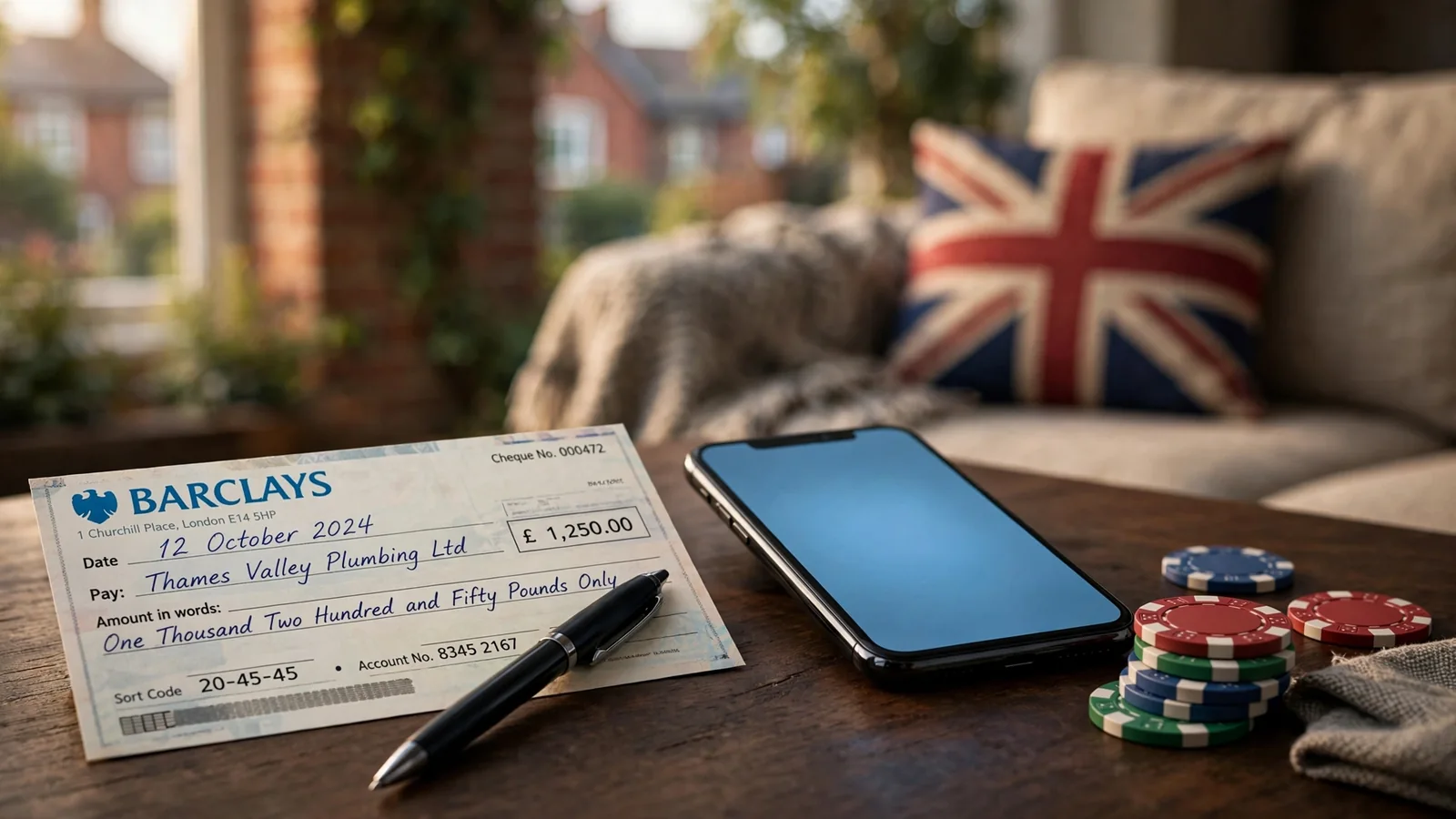
A bank cheque and a Pay by Phone deposit are different payment methods. A cheque is a payment instrument issued through a bank; Boku is a mobile payment service. When a casino cashier labels an option “Boku” or “Pay by Phone”, it does not mean that the casino accepts a paper cheque or a cheque issued by a bank.
The confusion comes from how payment options are described. Someone looking for a way to fund an online casino account may use “cheque” to mean a bank-linked payment, or may encounter a page about casinos that accept Boku and mistake it for information about bank cheques. The words can sit close together in broad payment discussions, but they point to different processes. The distinction matters because a cashier’s payment label describes the route used to collect the deposit, not just the fact that money comes from somewhere connected to a bank or account.
Boku works through a mobile phone. A deposit is charged to the customer’s mobile bill, or deducted from available prepaid credit. That makes it a Pay by Phone method. It does not turn the transaction into a bank-cheque deposit, and it does not mean the casino is processing a cheque behind the scenes. The payment is tied to the mobile account.
If you’re looking for a UK casino that accepts bank cheques, check the payment terms carefully: the information available here gives payout speed, but does not confirm cheque acceptance. The listed payout timeframe can still help you assess what to expect after a withdrawal.
Chanze
Chanze has a stated payout speed of 1–3 business days. This information does not confirm whether it accepts bank cheques.
Dieselwin
Dieselwin has a stated payout speed of 1–3 business days. This information does not confirm whether it accepts bank cheques.
SlotoSport
SlotoSport has a stated payout speed of 1–3 business days. This information does not confirm whether it accepts bank cheques.
Revery Play
Revery Play has a stated payout speed of 1–3 business days. This information does not confirm whether it accepts bank cheques.
BeOnBet
BeOnBet has a stated payout speed of 1–3 business days. This information does not confirm whether it accepts bank cheques.
Jetsetspins
Jetsetspins has a stated payout speed of 1–3 business days. This information does not confirm whether it accepts bank cheques.
NightWin
NightWin has a stated payout speed of 1–3 business days. This information does not confirm whether it accepts bank cheques.
Zombillion
Zombillion has a stated payout speed of 1–3 business days. This information does not confirm whether it accepts bank cheques.
Amunbet
Amunbet has a stated payout speed of 1–3 business days. This information does not confirm whether it accepts bank cheques.
SpinFormula
SpinFormula has a stated payout speed of 1–3 business days. This information does not confirm whether it accepts bank cheques.
In my experience, the practical test is the option shown in the casino cashier. If the cashier asks for a mobile number and identifies the method as Boku or Pay by Phone, the transaction is a mobile payment. A bank-cheque route would need to be identified as such; the presence of a phone-bill payment does not establish that the casino accepts cheques. Labels matter here. They determine how a payment is authorised and where the charge appears.
That is why a search for casinos that accept bank cheques can lead to pages about Boku without answering the cheque question. A page may be using “cheque” loosely, or its payment information may concern Pay by Phone rather than an actual bank cheque. Those are not interchangeable claims. The operator’s cashier is the relevant place to confirm which payment methods are available for an account, and the method name should be read literally.
There is a separate issue with the phrase “best casino sites that accept cheques”. It implies that there is a clear set of cheque-accepting casinos to compare. Boku availability does not establish such a set. A small number of UK Gambling Commission-licensed casinos still accept Boku deposits, but that is evidence of a mobile-payment option, not proof of bank-cheque acceptance. The direct-Boku market has also been shrinking since 2023, so an old payment listing may not describe what a cashier offers now.
A specialist review has identified Jackpot Mobile Casino and Peachy Games among a small set of remaining direct-Boku sites. That should be read narrowly: the names relate to Boku, not to a confirmed bank-cheque facility. Payment options can change, and a brand mentioned in an older description is not a substitute for checking the live cashier. No ranking follows from the fact that a casino accepts a particular deposit method.
The UK regulatory distinction also matters. Commercial online casinos serving customers in Great Britain must hold the relevant UK Gambling Commission licence. A payment method does not establish that status: Boku acceptance is not a licence, and cheque acceptance would not be one either. The operator’s current licence should be checked on the Commission’s public register before depositing. That is a separate check from confirming the cashier’s payment options.
For anyone comparing payment methods, the clean way to read the terminology is simple. “Bank cheque” means a cheque-based route if the operator expressly offers one. “Boku” means a Pay by Phone deposit charged through the mobile account. A casino listing that mentions only Boku has not answered whether it accepts bank cheques. Similar purpose, different plumbing.
A casino’s payment menu is not a permanent catalogue. It reflects the methods an operator chooses to support at a particular time, and those choices can change. A specialist casino-payment review describes a shift away from direct Boku since 2023: some operators moved to Fonix or Siru Mobile, while others removed Pay by Phone altogether. That is a reported direction of travel, not proof that every casino made the same change or that a method shown in an older review remains available now.
The distinction matters because “Pay by Phone” can describe a broader category, while Boku, Fonix and Siru Mobile are separate services. A casino may continue to offer a phone-based payment route after dropping Boku, but that does not make the replacement a Boku deposit. Conversely, a casino that no longer shows Boku may have removed phone payments altogether. Similar labels can conceal different providers.
From the operator’s side of the counter, a payment option is a commercial and operational choice, not a fixture. The cashier shows what the business has enabled; it is not a promise that the same selection will appear indefinitely. When the provider changes, the underlying payment route changes too. The name on an old comparison page can therefore outlast the arrangement it describes.
That creates a familiar problem for anyone comparing UK online casinos that accept bank cheques or other less conventional payment methods: pages may group unrelated methods under broad headings, or retain details after an operator has changed its cashier. The useful question is not simply whether a site once accepted Boku. It is whether direct Boku is currently offered, whether a different Pay by Phone service has taken its place, or whether no phone-based option is listed.
Those are three different outcomes. Treating them as one makes a comparison look more complete than it is. A replacement service may preserve the general idea of paying through a mobile account, but its name and availability should be checked separately. An operator that has removed Pay by Phone has not necessarily replaced it with another mobile payment route. The menu may simply have fewer choices.
I have seen how a familiar payment label can acquire a life of its own in casino descriptions. Once a method has been associated with an operator, a listing can be repeated even after the operator’s available options have moved on. That is why a list assembled from past mentions can be misleading: it records a history of claims, not necessarily the current cashier. Old information travels. The cashier is the test.
The change since 2023 should also be read carefully. The reported movement towards Fonix or Siru Mobile does not establish that either service is available at every operator that previously supported Boku. Nor does the removal of Boku at one site show that all UK casinos have removed it. The market is not moving in a single coordinated step; the reported pattern includes replacement and withdrawal, with different outcomes at different operators.
For a player, the practical consequence is that searching for a payment method by name can miss a replacement—or suggest one that is no longer present. A casino may still support Pay by Phone under another provider’s name, while another may have no such route. These are not interchangeable descriptions. “Mobile payment available” is too broad to settle whether the cashier accepts direct Boku.
The same caution applies to material labelled for a particular year. A date can make an old list look current without confirming the payment menu. Payment methods are part of an operator’s live setup, so the relevant evidence is the operator’s own current cashier or payment information. A third-party description can help identify what to look for, but it should not be treated as a standing guarantee.
This is why the remaining Boku options should not be inferred from older references or from the continued presence of another Pay by Phone service. The change is not merely a rebranding exercise: the reported outcomes include switching providers and removing the category. For a clear comparison, direct Boku, another mobile-payment provider and no phone option need to be recorded separately.
Small distinction. Big difference.
The names attached to Boku in specialist casino reviews form a reported set, not a league table. Those reviews have associated BoyleSports, Sun Bingo, William Hill, Sky Vegas, PlayOJO, Genting Casino, Betfred, Lottoland, bwin and 888 Casino with Boku deposits. That is useful as a starting point for checking payment availability, but it should not be read as a guarantee that every named cashier still offers the method. Payment menus can change, and a review can describe an earlier position.
The distinction matters for anyone looking for a UK casino that takes bank cheques. These operator names relate to Boku, a Pay by Phone option, not to cheque deposits. A payment method linked to a mobile account is not a bank cheque service, even if a search for one turns up the other. The available market picture is therefore about phone-bill deposits; it does not establish which casinos, if any, accept cheques.
Nor does a broad list answer the question of which casino is “best”. That word often implies a comparison of current payment access, terms and other features. A name in a specialist review does not prove that an operator offers the same cashier choices to every account, or that the payment option is available at the time a deposit is attempted. I would treat the name as a lead to verify, not as a recommendation.
BoyleSports has a more specific detail attached to it: a specialist review reported that the operator added Boku to its cashier as a UK-based payment option. This describes an addition recorded by that review. It does not, by itself, settle whether Boku remains available there now. The same distinction applies to every operator named in reviews: a reported association is not a live confirmation.
This is why lists headed “top casinos that accept cheques” can mislead when the underlying material concerns Boku. The list may contain real operator names, but the payment category has shifted. A phone-bill payment and a cheque are different routes, with different practical requirements. The operator’s cashier is the point at which current availability becomes clear; a review can help identify where to look, but it cannot replace that check.
I also separate three claims that are often compressed into one: an operator has been associated with Boku, the cashier currently displays Boku, and a particular account can complete a deposit using it. The first can appear in a review; the second depends on the current cashier; the third depends on the transaction being accepted. Treating those as interchangeable turns an old mention into a promise. That is too much to infer.
BoyleSports, Sun Bingo, William Hill, Sky Vegas, PlayOJO, Genting Casino, Betfred, Lottoland, bwin, and 888 Casino.
Check the live casino cashier to confirm if the method is currently offered to your account.
Verify the operator's current licence on the UK Gambling Commission's public register before depositing.
For legal status, the payment method is not a substitute for checking the operator. Remote gambling offered to consumers in Great Britain is regulated by the UK Gambling Commission, and operators serving that market need the relevant licence. A current licence can be checked on the Commission’s public register before depositing. That check establishes the operator’s regulatory position, not whether Boku is present in its cashier.
In practical terms, the remaining Boku market is best understood as a small, identifiable set of reported operator associations rather than a dependable ranking of cheque-taking casinos. The names can direct a more precise check, but they do not turn Boku into a bank-cheque option or guarantee that the payment will be offered today. Separate categories. Current cashier. Valid licence.
A Boku transaction starts in the casino’s cashier, not with a cheque form or a bank transfer. Once Boku appears among the available payment methods, the deposit flow asks for an amount and the mobile number linked to the payment. The number matters: Boku routes the charge through the mobile network, so the SMS confirmation has to reach the phone associated with that number.
After the details are entered, the player receives a verification code by text. Entering that code confirms the payment request. The casino cashier and the phone therefore do different jobs: the cashier records the intended deposit, while the SMS step authorises the mobile payment. A bank cheque deposit at an online casino follows no part of this sequence; Boku is Pay by Phone, not cheque processing.
The amount field has a practical restriction in the available account of Boku transactions: deposits are described as being accepted in amounts divisible by ten, such as £10, £20 or £30. That should be treated as a detail reported by a specialist review, not as a guaranteed rule across every casino and network. The cashier is the point at which the available amounts for a particular account become clear. If an entered figure is rejected, changing the number to one that fits the displayed options is more useful than assuming the payment has been submitted.
The sequence is simple, but it is not the same as a card checkout. There is no card number to enter in the Boku flow; the mobile number and the one-time text code form the key payment details. I have seen payment pages make the method sound like a generic “instant deposit”. That label skips the part that matters: authorisation depends on the phone and its network, not just on clicking a button in the casino.
A failed SMS confirmation does not establish that a deposit has gone through. Until the verification step is completed and the cashier shows the transaction as accepted, the payment request should not be treated as a credited balance. If the code does not arrive or the number is wrong, the transaction cannot be confirmed through that phone. Avoid repeatedly submitting requests without checking the cashier’s status, since that can make it harder to tell which attempt was accepted.
Before starting, the casino account itself must be eligible to deposit: operators have to verify a customer’s age before accepting funds, and the site must hold a current UK Gambling Commission operating licence to serve Great Britain. The licence should be checked on the Commission’s public register. Those checks sit outside the Boku confirmation sequence, but they are part of the same payment decision. A working SMS code does not establish that the casino is properly licensed.
Boku Deposit Process
Select Method
Choose Boku in the casino cashier and enter the deposit amount and linked mobile number.
SMS Verification
Receive a verification code via text message on the provided mobile phone.
Confirm Payment
Enter the code into the cashier to authorize the transaction and credit the balance.
The key distinction is between entering a payment request and confirming it. Select Boku in the cashier, provide the amount and mobile number, then complete the SMS verification. The amount options may be constrained, and the exact choices need to be read in the cashier rather than assumed from a general description. No cheque is involved.
There was no UK Gambling Commission rule naming Boku and prohibiting casinos from accepting it. When operators removed the payment method, that was a business decision made against a compliance-risk background, not the result of a Boku-specific ban. The distinction matters: a payment option disappearing from a cashier does not mean the regulator issued a rule about that particular service.
The Commission regulates gambling, including online casino activity. In Great Britain, it is the sole regulator for commercial gambling, and remote operators serving consumers there fall within its remit regardless of where their key equipment is located. Its licensing system covers businesses through operating licences and individuals through personal licences.
That framework concerns the operator’s gambling activity, not approval of every payment method it chooses to offer. An operator remains responsible for how its services operate within the regulatory system. From inside the business, payment decisions are therefore not just a matter of whether a transaction can be processed. The operator also has to decide whether it is comfortable with the risks attached to that route.
This is why a bank cheque and Boku should not be treated as interchangeable. A search for casinos accepting cheques in the UK describes a bank-payment question; Boku is a phone-bill payment method. Nor does a casino’s decision to stop accepting Boku establish that online casinos accepting cheque payments are subject to a special Commission rule. Those are separate payment arrangements, even when they appear together in broad descriptions of casino funding.
The commercial calculation can be cautious without there being a new ban. If an operator judges that a payment channel creates compliance concerns it would rather not manage, it can remove the option from its cashier. That choice may affect customers, but it does not make the decision a regulator-imposed prohibition. The responsibility sits with the operator.
I have seen payment menus treated as simple product features in promotional copy. In practice, each one is also an operational decision. “Available” tells little about why a method remains in place; “banned” can be just as misleading when no method-specific rule exists. The useful distinction is between the Commission’s broad regulatory authority over gambling in Great Britain and each operator’s choice about whether to support Boku.
For a legal online casino serving customers in Great Britain, the relevant operating licence belongs to the business offering the gambling service. The Commission also issues personal licences to individuals working in regulated roles. Those are parts of the same framework, but neither fact turns Boku itself into a separately approved or prohibited casino payment method. The line is clear.
Licence Verification
Boku acceptance is not a substitute for a licence; always check the UK Gambling Commission's public register to ensure the operator is legal.
A deposit method and a bonus are separate parts of the offer. A casino may accept Pay by Phone without treating that payment as eligible for a welcome promotion. In my experience, the distinction often sits in the terms rather than in the cashier: the deposit goes through, but the promotion’s qualifying conditions may not be met.
Eligibility is not consistent across operators. A specialist review reported that MrQ, Duelz, Mr Vegas and Videoslots accepted Pay by Phone deposits for bonus eligibility. That is a report about those operators, not a rule that applies across the market or a guarantee that a particular promotion remains unchanged. Offers and terms can be revised, so the relevant wording is the one attached to the offer at the time it is claimed.
Boku needs a similarly careful reading. A specialist review found no Boku-specific bonus and no restrictions on Boku deposits at the platforms it assessed. That does not mean every Boku payment qualifies for every promotion. It means the review did not identify a separate Boku bonus or a deposit restriction there. The operator’s current promotional terms still decide eligibility.
The useful distinction is between a payment-method restriction and the other conditions of an offer. Terms may state which deposit methods count, what action qualifies an account for a promotion, and how bonus funds can be used or withdrawn. A deposit being accepted is not evidence that it satisfies every promotional condition. Nor does the absence of a Boku-specific exclusion establish that all offers accept it.
This is where promotional language can mislead without being technically false. “Welcome bonus” describes the offer, not automatic eligibility for every payment route. The payment can appear in the account while the bonus does not attach. Read the method-specific wording alongside the offer’s full conditions, rather than relying on a general cashier label or a previous promotion.
For anyone comparing casinos based on bonuses, the practical question is not simply whether Boku appears as a deposit option. It is whether the exact offer allows that method and whether the remaining terms are acceptable. That check matters even where a review has recorded Pay by Phone deposits as eligible elsewhere.
One more distinction. A bonus being available does not make it valuable on its own; its conditions govern how it can be used. The terms are the operative part, not the headline.
A Boku deposit can be constrained by the amount allowed in one transaction, a daily limit applied by the mobile network, and—on a pay-as-you-go phone—the credit left on the account. These are separate checks. A casino cashier may accept an amount that the network later rejects, or the phone balance may be too low to cover it.
The published figures are not consistent. One specialist review describes £30 as the standard UK transaction limit, with some casinos or network operators permitting £40 or £50. Other payment information describes a £10 transaction limit alongside a £30 daily network cap. A further account gives the daily figure as £30 but specifies no separate transaction cap. Those versions cannot be combined into one dependable rule: the stated per-transaction limits disagree, and some accounts do not state one at all.
That difference matters in practice. A per-transaction cap concerns a single payment attempt; a daily cap concerns the total processed through the mobile account over the day. Treating the daily figure as the maximum for each individual deposit would confuse the two. Treating a quoted transaction limit as universal would be just as unreliable, since the figures vary across descriptions and may depend on the casino or network.
The allocation of responsibility is clearer in a specialist review’s account of the process: the mobile operator, rather than the casino, enforces the daily Boku limit. The casino presents the payment option and submits the charge, but the network’s controls can determine whether it proceeds. A declined payment therefore does not necessarily mean that the casino has imposed its own deposit cap. Different gatekeepers.
PAYG credit is a separate constraint, not another name for the daily limit. A specialist review describes prepaid Boku payments as limited to the remaining balance on the phone. If that balance cannot cover the requested deposit, the payment may be declined even when the daily allowance has not been used up. A monthly-billed customer does not face that particular balance test, although network and casino limits may still apply.
I would read a displayed limit as applying to that cashier and payment route, not as a promise about every Boku account. The casino’s permitted amount, the network’s daily control and available PAYG credit can all affect the result. For bank-cheque searches, these figures should not be mistaken for cheque-deposit limits: they describe Boku, a phone-bill payment method.
Boku is a way to put money into a casino account, not a way to take winnings back out. The distinction matters because a payment option shown in the cashier does not necessarily work in both directions. A Boku deposit cannot be returned to the phone bill or mobile balance as a casino withdrawal.
I have seen payment labels treated as if they describe a complete banking route. They do not. The cashier may accept a phone-bill payment when an account is funded, while the withdrawal process requires a separate method. That is a structural limit of Boku, not a delay or a setting that can be changed after a win.
A separate withdrawal method is therefore part of the practical setup when Boku is used. UK-licensed casinos require customers to have an available route for withdrawals; this may be a debit card, an e-wallet or a bank transfer, depending on the operator’s options. The casino’s cashier and terms determine which methods are available for that account. “Pay by Phone” describes the deposit side only.
There is also a possible indirect route through Neteller. A specialist review has reported that Boku can be used to fund a Neteller account, which can then be used to deposit at casinos that accept Neteller. That is not the same as withdrawing casino winnings to Boku. The money first moves through a separate e-wallet, and Neteller’s acceptance at a casino remains an operator-specific matter.
That distinction is easy to lose in promotional wording. Calling a payment option “flexible” may mean it can be used to fund an account; it does not establish that it can receive withdrawals or that every casino accepts the same route. The money path has more than one gate.
For a player searching for a casino that accepts cheque deposits, the key practical question is still where winnings can be paid. A phone-bill deposit does not turn into a cheque withdrawal, and Boku itself cannot serve as the return destination. The casino must support a separate withdrawal option, and that option needs to be available for the account before money is deposited.
In my experience, this is where the cashier’s small print matters more than the payment badge. Deposit and withdrawal methods are separate decisions. A working deposit route is only half the arrangement.
A Boku deposit does not arrive as a bank transfer or a cheque payment. The charge is routed through the mobile account: on a contract plan it appears on the monthly phone bill, while on a pay-as-you-go plan it is taken from the available prepaid credit. That distinction matters because the payment is tied to the mobile service, not to a bank account.
I have found that the cashier label can make the route sound more abstract than it is. “Pay by Phone” means the casino is asking the mobile network to handle the charge. The amount is then collected through the billing arrangement attached to the number used for the transaction. With PAYG, the balance itself is the source of funds; with a monthly plan, the charge is added to the bill. No separate cheque or card settlement is involved.
The network names associated with UK Pay by Phone arrangements are EE, O2, Vodafone and Three. Fonix is also supported across those networks. That does not make every casino payment option interchangeable: a cashier may show Boku, Fonix or another service, and availability depends on the payment method offered by that operator. The network connection is only one part of the route.
This is where the wording on a payment page can mislead. A casino may describe a deposit as mobile payment, but the practical question is where the cost lands: on a monthly mobile bill or against PAYG credit. The billing route can be clear even when the name in the cashier is not.
For someone looking for a bank-cheque casino, this is a different mechanism entirely. A phone-bill deposit uses the mobile account as the collection point; it does not mean the casino accepts a cheque drawn on a bank. The distinction is easy to miss when payment labels are compressed into a short cashier menu. Different route, different account.
A quoted Boku schedule gives a minimum deposit of €10, a maximum of €30 and a monthly cap of €240. Those figures are in euros. They should not be read as a universal limit for UK casino deposits, still less as a rule for paying by bank cheque. The currencies and payment methods are different; the label “bank cheque casino” does not turn a Boku limit into a cheque condition.
There is also a direct conflict in the reported limits. The euro schedule sets a per-deposit maximum of €30, while a specialist review of UK Boku payments describes £30 per transaction as the standard limit and says some operators or networks may permit £40 or £50. These are not equivalent figures, and neither should be silently substituted for the other. They may reflect different payment arrangements or information gathered at different times.
From the operator side, a published ceiling is only useful when it matches the cashier and payment route actually offered. A monthly cap in euros cannot establish what a UK account can deposit today, and a pound-denominated transaction figure does not confirm a monthly allowance. The distinction matters: one describes a stated monthly total, the other a transaction ceiling.
I would treat the €10, €30 and €240 figures as one quoted schedule, not as a market-wide promise. The cashier’s displayed terms are the relevant operational detail for that account. No cheque rule follows from them. Different method entirely.
Boku deposits are typically limited to £30 per transaction, although some casinos or mobile networks may allow up to £40 or £50. Network-level limits can be about £10 per transaction and £30 per day, and PAYG users are also limited by their remaining phone credit.
Some operators have dropped Boku because of compliance risk. Since 2023, others have switched to services such as Fonix or Siru Mobile, while some have removed pay-by-mobile payments altogether.
Choose Boku in the casino cashier, enter an eligible amount and your mobile number, then confirm the payment using the SMS verification code. Deposits are charged to your monthly phone bill or deducted from PAYG credit.
Fonix and Siru Mobile are pay-by-phone alternatives offered by some casinos. You can also use Boku to fund a Neteller account, then deposit at a casino that accepts Neteller.