Boku uses a mobile bill or prepaid credit and SMS confirmation, but those details do not verify Apple Pay acceptance.
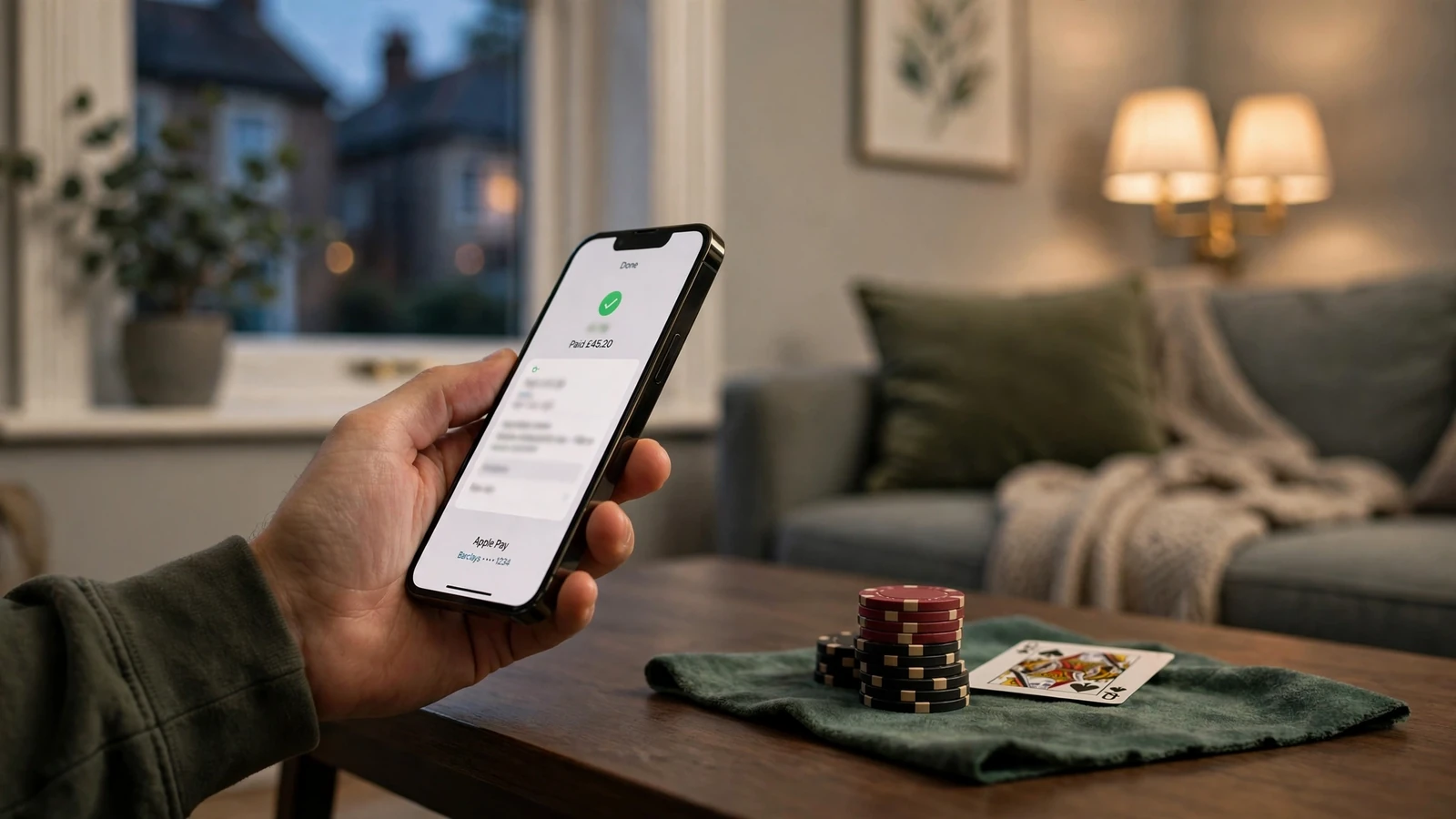
Apple Pay is a specific payment method, not a general name for paying from a phone. In UK casino discussions, it is easy for mobile payments to blur together: Boku and other Pay by Phone services also involve a handset, but that does not make them Apple Pay. A casino cashier listing one method cannot, on that basis alone, be described as accepting another.
That distinction matters when assessing claims about casino accounts, deposits or bonuses linked to Apple Pay. A payment option has to be identified by the method the operator actually offers. Similar wording, or the fact that a phone is involved, is not enough to establish that two services are interchangeable. The labels matter. So does the cashier.
Boku is a Pay by Phone method. Its deposits are charged to a mobile bill or deducted from prepaid credit, and a transaction is confirmed through an SMS process. Those details describe how Boku works; they do not establish anything about Apple Pay acceptance. The two should not be folded into one category simply because both may appear in a discussion of paying by mobile.
When choosing a UK casino that accepts Apple Pay, check the cashier for current deposit options as well as the withdrawal terms. The entries below include the payout-speed information available for each operator.
Chanze
Chanze lists a payout speed of 1–3 business days. Apple Pay availability is not specified in the information provided.
Dieselwin
Dieselwin lists a payout speed of 1–3 business days. Apple Pay availability is not specified in the information provided.
SlotoSport
SlotoSport lists a payout speed of 1–3 business days. Apple Pay availability is not specified in the information provided.
Revery Play
Revery Play lists a payout speed of 1–3 business days. Apple Pay availability is not specified in the information provided.
BeOnBet
BeOnBet lists a payout speed of 1–3 business days. Apple Pay availability is not specified in the information provided.
Jetsetspins
Jetsetspins lists a payout speed of 1–3 business days. Apple Pay availability is not specified in the information provided.
NightWin
NightWin lists a payout speed of 1–3 business days. Apple Pay availability is not specified in the information provided.
Zombillion
Zombillion lists a payout speed of 1–3 business days. Apple Pay availability is not specified in the information provided.
Amunbet
Amunbet lists a payout speed of 1–3 business days. Apple Pay availability is not specified in the information provided.
SpinFormula
SpinFormula lists a payout speed of 1–3 business days. Apple Pay availability is not specified in the information provided.
From the other side of the counter, payment pages are operational, not decorative. Each listed option represents a particular route for funding an account, with its own conditions and processing arrangements. A casino’s general reference to mobile payments does not necessarily tell the whole story. The named method is the useful detail. If the name is Boku, the claim is about Boku.
The same care applies to claims about an Apple Pay deposit and a casino bonus. Payment acceptance and bonus eligibility are separate conditions. A bonus may have its own terms, and the presence of one payment method does not establish that another method qualifies. “Bonus available” is a broad marketing phrase; the payment conditions decide what happens in practice. No shortcut there.
Searches for casino sites that take Apple Pay can also mix several different questions. One is whether an operator supports that method for deposits. Another is whether an account can be opened, whether a particular promotion applies, or whether a certain game can be played. These are not interchangeable claims. A statement about one does not settle the others, and a list of Pay by Phone options is not an Apple Pay casino list.
Nor does the word “slots” change the payment question. A game title and a cashier option belong to different parts of the service. A casino may offer games while providing particular payment methods; the existence of games does not identify those methods. I have seen promotional language make these distinctions look smaller than they are. They are not. Different systems.
For UK players, the regulatory frame is also separate from the payment label. The UK Gambling Commission regulates remote gambling offered to consumers in Great Britain, and operators serving that market must hold the relevant licence. A licence is not proof that a casino accepts Apple Pay, just as a payment method is not proof of regulatory status. Each claim needs to be checked on its own terms. The UKGC public register is the place to verify a licence before depositing.
A claim about casinos outside GamStop does not resolve the payment question either. GamStop status and cashier options describe different things. Neither can be inferred from the presence of Boku or another Pay by Phone service. Combining labels in a promotion does not turn them into evidence of one another.
The practical way to read payment language is to keep the method, the transaction and the offer distinct. “Pay by Phone” tells a different story from “Apple Pay”; a deposit option says nothing by itself about a bonus; and a game catalogue does not confirm how an account can be funded. Marketing tends to compress these details into one reassuring line. The cashier terms are more exact.
So, when Apple Pay is the specific requirement, a reference to Boku should not be treated as a substitute or confirmation. Boku information can explain a Pay by Phone arrangement, including billing and SMS confirmation. It cannot be stretched into a statement about Apple Pay, Apple Pay slots, or an Apple Pay bonus. Different method. Different claim.
A casino advertised as accepting Apple Pay should be identifiable by a clear deposit option, not by a broad claim that it supports mobile payments. Those are not interchangeable descriptions. A payment method needs to be confirmed for the specific casino and for deposits; a general reference to phone payments does not establish Apple Pay acceptance.
I would not put an operator on a list of casinos accepting Apple Pay unless its deposit information actually names Apple Pay. The distinction matters because a list can look precise while resting on a loose interpretation: a site may support several ways to pay, but that does not prove it supports the one being searched for. “Apple Pay supported” is a specific claim. It needs specific confirmation.
That is why naming supposed “best” Apple Pay casinos would be misleading here. This is not a ranking issue, and it is not a judgement about the quality of any casino. It is a boundary around what can responsibly be stated. A polished cashier, a casino app or a general statement about digital payments does not by itself settle the acceptance question.
The same care applies to claims about instant banking, Bitcoin or other payment routes. Their appearance beside Apple Pay in a list or advert does not show that they are the same method, or that Apple Pay is available. Each payment option has to be assessed on its own terms. Grouping unlike methods under a phrase such as “fast deposits” makes the marketing easier to read, but leaves the important detail unclear.
In practice, the meaningful check is the casino’s own deposit information: does it identify Apple Pay as a method for funding a gambling account? A mention elsewhere on a site may describe a different product or a general service rather than the casino cashier. If the wording does not connect Apple Pay to casino deposits, it should not be treated as confirmation. A claim without that connection remains a claim.
The same standard should apply to “new” casinos. A recent launch date does not establish which deposit options the operator accepts. Nor does a casino’s availability as an app prove that Apple Pay can be used to deposit. The product, the app and the cashier are separate things. Marketing can blur them; the payment label needs to be explicit.
There is a regulatory check alongside the payment check. The UK Gambling Commission oversees commercial gambling in Great Britain, and operators offering real-money gambling to customers there must hold the relevant Commission licence. A licence does not prove that a casino accepts Apple Pay; it establishes the operator’s regulatory position, not a particular payment feature. I treat those as separate checks. Before depositing, the licence should be verified on the Commission’s public register.
That separation matters when a list combines payment claims with other labels, such as “not on GamStop” or “instant.” Those descriptions do not confirm Apple Pay acceptance. They also do not replace the need to establish that a casino serving British customers has the required UKGC licence. One label cannot stand in for another. Different question, different proof.
There is a practical difference between an option being mentioned in promotional copy and an option being available at the point of deposit. The cashier is where a payment method must be presented as a way to fund the account. If Apple Pay is not explicitly identified there or in the operator’s relevant payment terms, the safer reading is not to assume acceptance. That avoids turning a vague phrase into a promise about how a deposit can be made.
I have seen payment wording treated as a shortcut: one method is named, another is inferred, and the inference becomes a headline. That is how an unconfirmed operator can end up on a list of Apple Pay casinos without the underlying claim being established. The headline may be confident. The detail is what counts.
So a list of casinos that accept Apple Pay should include only operators with direct, operator-specific confirmation of Apple Pay deposits. Keep payment acceptance distinct from app availability, other payment options and licensing status. Precision first. No guesswork.
A slot does not become an “Apple Pay slot” because it appears in a casino’s games catalogue. Apple Pay is a payment method; a game is a separate product. Treating the two labels as if they describe the same feature can make a casino’s game selection look like proof of how its cashier works. It is not.
That distinction matters for searches about the best Apple Pay games, mobile slots or newly released titles. A game’s name, format or availability on a phone cannot establish that a casino accepts Apple Pay. Nor does a casino offering a particular slot show that the slot itself has any Apple Pay function. Payment acceptance, where available, belongs to the operator’s payment arrangements rather than to an individual game.
I have seen promotional wording make these categories blur together. “Mobile” may describe a game that works on a phone; it does not identify a payment option. “New” may describe a recent release; it says nothing about the cashier. And “best” is a judgement about quality or preference, not a verifiable payment feature. The label is doing too much.
The same applies to claims about the best Apple Pay casino games or the best slots for an Apple Pay deposit: those descriptions combine two separate questions and do not answer either one on their own.
A useful comparison starts with the game itself. Its theme and play are one matter; the operator’s accepted deposit methods are another. A casino may offer a broad catalogue without every payment method being available, and a payment option does not identify which games are offered. These details need to be checked separately. No shortcut in a game label bridges the gap.
The same caution applies to mobile play. A slot that can be opened on a mobile device is not, for that reason, an Apple Pay slot. The device, the game and the payment route are different parts of the experience. Bundling them into one phrase may be tidy marketing, but it does not make the underlying connection real.
I would not use an Apple Pay label to choose a game, judge a bonus or infer a casino’s payment arrangements. Those are separate decisions, and each needs its own reliable description. A game title cannot confirm a bonus condition; a bonus headline cannot confirm a payment method; and neither establishes that Apple Pay is accepted.
For game-related comparisons, the sensible boundary is plain: discuss a slot as a slot, and describe Apple Pay only when an operator’s payment information actually confirms it. Without that separation, a list of “Apple Pay slots” risks presenting ordinary game titles as though they carried a payment feature. They do not.
That is not the same as establishing that none does; it means an operator should not be presented as an Apple Pay option without a current, operator-specific confirmation. I have learned to treat payment labels cautiously: a method mentioned in general casino material is not necessarily available in the cashier when an account is opened.
The distinction matters because payment availability is not a permanent property of a brand. A casino can change its cashier options, and what appears in a general description may not match the methods offered to every customer. A confident-sounding list can therefore create the wrong impression. Without confirmation from the operator, calling a site one of the best Apple Pay casinos would be an endorsement built on an unconfirmed claim.
There are several separate questions hidden inside the idea of “acceptance”. Does the operator allow Apple Pay for deposits? Is the option available to UK customers? Does it appear for a particular account, device or cashier session? And does the same method support withdrawals? An answer to one does not settle the others. Deposit acceptance, in particular, should not be taken to mean that winnings can be paid back through the same route.
I would look for a direct statement in the casino’s own payment information and then check that the method is actually offered at the cashier before treating the claim as settled. The wording needs to identify Apple Pay itself, rather than use a broad phrase such as “mobile payments” or “digital wallet”. Those labels can cover different services. Marketing language is not a payment instruction.
The UK regulatory position is a separate matter. Commercial operators offering real-money gambling to customers in Great Britain must hold the relevant UK Gambling Commission licence, wherever their key equipment is located. The Commission issues operating licences to businesses and regulates remote gambling supplied to consumers in Great Britain. That framework helps establish whether an operator is authorised to serve the market; it does not confirm which payment methods its cashier supports.
In my experience, those two checks are too often blurred. A casino’s legal status and its payment menu answer different questions. A valid licence does not establish Apple Pay acceptance, and a payment logo does not establish that an operator is licensed for the British market. Each claim needs its own confirmation.
Clear distinction.
Apple Pay and card restrictions are separate questions. Whether a casino accepts Apple Pay is not answered by the rules on credit-card gambling. A payment option may be described as Apple Pay, but that label alone does not establish whether a particular casino accepts it or what kind of card funding is permitted. Acceptance has to be established for the operator and the payment route in question.
The distinction matters because UK-licensed casinos cannot take credit-card payments for gambling. The restriction also covers credit-card funds routed through a money service business. It is not limited to a card entered directly into a casino cashier.
Wallet payments have a related restriction: operators cannot accept them for gambling where the wallet allows credit-card funds to be used. That is a rule about the source and route of funds, not a blanket statement that every digital wallet is prohibited. Nor does it establish that Apple Pay is accepted, rejected, or treated identically by every casino. The details of the payment route matter.
A debit card is not a credit card, so the credit-card prohibition should not be casually extended to all card payments. But that distinction does not prove that a casino accepts Apple Pay linked to a debit card. The method’s name and the card’s funding type answer different questions. One concerns the casino’s available payment methods; the other concerns whether the funds come from a prohibited credit source.
This is where payment wording can become misleading. “Card payments accepted” does not necessarily mean every card type or every digital-wallet route is available. Equally, a restriction on credit-card gambling is not evidence that a debit-card wallet payment will work. Those claims need to be kept apart.
The regulatory framework sits behind the restriction. The UK Gambling Commission oversees commercial gambling in Great Britain, including remote casino services offered to consumers there, even when an operator’s key equipment is located elsewhere. It issues operating licences to businesses and personal licences to individuals working in the regulated gambling sector. That licensing role is broader than payment processing: it does not itself tell a player which options appear in an individual casino’s cashier.
In practice, the useful distinction is simple: Apple Pay acceptance is an operator-level payment question; credit-card gambling is a regulated funding restriction. A casino cannot use a wallet route to make credit-card gambling permissible where the rules prohibit it. At the same time, that rule should not be presented as a verdict on debit cards or as proof of Apple Pay availability.
No shortcut. A payment logo cannot settle both questions.
For casino deposits, Pay by Phone is a separate payment route from Apple Pay. The amount is charged through a mobile network rather than paid from a card held in a digital wallet. That difference matters: a familiar phone-based checkout does not make the two methods interchangeable.
Accepted by operators such as MrQ and Duelz.
Accepted by operators such as Mr Vegas and Videoslots.
A Pay by Phone method that some operators have replaced with Fonix or Siru Mobile since 2023.
The UK operators that support Pay by Phone and Fonix include EE, O2, Vodafone and Three. Network support is only one part of the transaction, though. A casino must also offer the relevant payment method in its cashier, and the available option can differ between operators.
Some casinos have moved away from Boku, replacing it with Fonix or Siru Mobile; others have removed Pay by Phone altogether. A specialist payment review describes this shift as having taken place since 2023. It is a change in how some operators handle phone-billed deposits, not evidence that these services reproduce Apple Pay’s checkout or card-wallet functions.
The same review identifies MrQ and Duelz as accepting Fonix, and Mr Vegas and Videoslots as accepting Siru Mobile. Those names illustrate that Pay by Phone is not one uniform product: the service presented at the cashier depends on the operator. A payment brand appearing on one casino does not establish that it is available across the market.
From the operator’s side, offering several payment rails means managing separate arrangements and conditions. From the player’s side, the practical distinction is simpler: a deposit charged through a mobile network follows that network’s payment route, while Apple Pay is a wallet-based method. Calling one an “alternative” can be useful only in the broad sense that both may be considered when choosing how to fund an account. It does not imply equal availability or matching features.
There is no sound basis for calling Fonix or Siru Mobile the “best” Apple Pay replacement. That would require a like-for-like comparison, and the labels alone do not provide one. Nor does a casino’s support for one of these services establish that it accepts Apple Pay. Different rails. Different acceptance.
Pay by Phone options can also disappear or change as operators revise their cashier arrangements. The movement away from Boku towards Fonix or Siru Mobile is therefore relevant when checking a particular casino, but it should not be read as a guarantee that any named option remains available. The payment method shown at deposit is the operative detail.
In industry terms, a payment method is not a feature of the handset; it is an arrangement between the operator, payment provider and, for Pay by Phone, mobile network. That is why seeing a phone number or a mobile-friendly checkout says little by itself about which payment rail is being used. A mobile screen is just the interface. The underlying route determines the method.
That is narrower than claiming none do: acceptance may exist, but a confident operator-by-operator list would require current, direct confirmation.
That distinction matters because a payment logo or a general reference to card payments does not, by itself, establish that Apple Pay can be used for a casino deposit. Nor does a mention of Apple Pay elsewhere on a site prove that it is available in the casino cashier. The specific deposit route is what counts.
The date matters, too. Payment options change as operators revise their cashier arrangements. A statement that was accurate at one point cannot automatically be carried forward into 2026. “Accepted” needs to describe the live deposit option, not an old review, an advertising claim, or a general description of the operator’s payment services.
I would not turn an uncertain position into a list of recommendations.
A useful confirmation would identify the operator, the date checked and Apple Pay as an available way to fund a gambling account—not merely a payment brand mentioned in broader terms. Until that level of confirmation exists, claims about Apple Pay casino deposits should be treated as unconfirmed rather than as a dependable basis for choosing a site.
I have seen how a payment label can carry more certainty in promotion than it does at the point of transaction. The cashier is where an advertised option either appears for the intended deposit or does not. For a date-specific claim, the distinction is decisive.
This does not settle whether acceptance exists across the market; it sets a boundary on what can be claimed with confidence.
Boku is a Pay by Phone method, not an Apple Pay card payment. The distinction matters at the cashier: choosing Boku means authorising a charge through the mobile number entered, rather than selecting a card held in a digital wallet.
The deposit flow is straightforward. Boku must appear among the casino’s available payment methods; select it, enter the deposit amount and provide the mobile phone number associated with the payment. The transaction is then confirmed with a verification code sent by SMS. Entering the number alone does not complete the deposit. The code is the confirmation step.
Once approved, the cost is applied through the mobile account. For a contract plan, it can be added to the monthly phone bill. For a pay-as-you-go plan, it is deducted from the available credit. In both cases, the mobile network is part of the payment route. It is not an Apple Pay transaction simply because the process uses a phone.
That is the practical answer for anyone comparing phone-based deposits with Apple Pay at a UK casino: Boku explains one specific Pay by Phone process. It does not establish that a casino accepts Apple Pay, that a particular deposit amount is available, or that a payment qualifies for a bonus. Those are separate cashier and offer conditions, not consequences of entering a number or receiving an SMS.
From the operator’s side, the cashier has to show the method for the account in question. If Boku is absent, there is no Boku flow to complete there. If it is present, the phone number and SMS confirmation connect the deposit to the mobile account. No card details are entered in this process.
A phone in hand, but a different payment rail.
A deposit method and a withdrawal method are not necessarily two directions of the same payment route. Boku is a clear example: it can be used to put money into a casino account, but casino funds cannot be paid back through Boku. The deposit route ends at the account.
Boku Deposit Process
Selection
Select Boku from the casino’s available payment methods in the cashier.
Entry
Enter the deposit amount and provide the mobile phone number associated with the payment.
Verification
Enter the verification code sent by SMS to complete the transaction.
Billing
The cost is applied to the monthly phone bill for contract plans or deducted from prepaid credit for pay-as-you-go plans.
That distinction matters when comparing cashier options. A payment button visible beside the deposit amount does not, by itself, show that the same option is available for withdrawals. For Boku, the limitation is explicit: it is deposit-only. A separate withdrawal method must be registered before funds can be paid out.
From the operator’s side, deposit acceptance and payout capability are separate functions. The cashier may offer a phone-bill payment for incoming funds while relying on another method for outgoing funds. That is not a technicality to leave until a withdrawal is requested. The account needs a usable alternative.
Apple Pay searches about casino withdrawals raise a different question. The fact that Boku cannot process a payout says nothing about whether a casino supports Apple Pay for withdrawals, whether Apple Pay can be used for deposits, or how quickly a payout would arrive. Those are separate claims, and none can be inferred from Boku’s deposit-only status. No shortcut there.
I have seen payment labels treated as if they describe a complete cash-in and cash-out service. They do not. A method can be available at deposit stage and absent from the withdrawal menu; Boku demonstrates precisely that split. So an Apple Pay label, if encountered, would still need to be understood in context: the deposit cashier and the withdrawal cashier may not offer identical routes.
The practical point is straightforward. Boku users need another registered withdrawal option, and the availability of that option is determined by the casino’s own cashier arrangements. Boku itself cannot return winnings. Nor does its limitation establish that Apple Pay is, or is not, a direct withdrawal method at any UK casino.
For a UK account, the operator must hold the appropriate Gambling Commission licence. That licensing requirement is separate from payment functionality: a licence does not establish which methods appear in a cashier or how a particular payout is handled. Payment route and regulatory status are different checks.
GamStop status and Apple Pay acceptance describe different things. One concerns whether an operator is covered by a self-exclusion scheme; the other concerns a payment option in the casino cashier. A claim about one does not establish the other. A casino described as outside GamStop cannot therefore be treated as an Apple Pay casino on that basis alone.
The reverse also applies. Seeing Apple Pay mentioned in connection with a casino would not establish whether that operator is covered by GamStop. Nor does a phrase such as “not affected” explain the reason for the status or establish that the operator is authorised to serve customers in Great Britain. These are separate checks, not interchangeable labels.
I have seen payment and account-status wording placed close together in promotional material, where the layout can make two unrelated claims look like one package. The distinction matters. Payment availability is set out through the operator’s cashier and terms; regulatory status is a separate matter. A “no fee” claim, if made, would need its own terms and would not prove Apple Pay is available or say anything about GamStop.
For British customers, the legal position is not determined by a payment badge or a GamStop description. Remote gambling operators serving consumers in Great Britain must hold the relevant UK Gambling Commission licence. The Commission regulates commercial gambling in Great Britain and issues operating licences to businesses. A licence check does not confirm a payment method, and a payment-method claim does not confirm a licence.
The same separation applies to slots. A game’s availability does not show that its casino accepts Apple Pay, and a casino’s stated GamStop position does not establish which games or payment methods it offers. The labels answer different questions.
Before depositing, the operator’s licence should be checked on the UK Gambling Commission’s public register. Payment terms and account-status claims require their own confirmation. Two labels. Two checks.
Boku is commonly limited to about £10 per transaction and £30 per day at network level. Some casinos or network operators may allow up to £40 or £50 per transaction, while PAYG deposits cannot exceed the remaining phone credit.
Yes, a small number of UK-licensed casinos still accept Boku, including BoyleSports, Sun Bingo, William Hill, Sky Vegas and 888 Casino.
Fonix and Siru Mobile are pay-by-phone alternatives used by some casinos. MrQ and Duelz accept Fonix, while Mr Vegas and Videoslots accept Siru Mobile.
Operators have dropped Boku because of compliance risk; the UK Gambling Commission did not introduce a specific ban on Boku.
Yes. Bonus eligibility for pay-by-phone deposits varies by operator, so check the casino’s promotion terms before depositing.
Choose Boku in the casino cashier, enter the deposit amount and mobile number, then confirm the transaction using the SMS verification code. The deposit is charged to your monthly phone bill or deducted from your PAYG credit.